Dual-purpose Chickens – 8 – Winter Water

In fall of 2014 I decided I wanted to raise some dual-purpose chickens.  My focus is on a breed that lays good eggs which can be incubated to raise “panfry” broilers, pre-Cornish-Cross size meat birds.  So, how do I keep the water from freezing?

One of banes of winter is frozen livestock water.  In the past, we’ve use 3 plastic 1 gallon waterers and rotated them throughout the day, bringing the frozen  ones in to thaw.  This was not an optimal solution.


I did some searching and was intrigued by an idea of using a tire to accumulate solar heat, and straw and a board inside the tire as insulation.  However, that would not work around here once the temperatures dropped well below freezing.


The idea I settled on was to use a concrete block with a light bulb inside, especially since the coop was going to be close to a power source.  It was easy to make.  Just an extension cord, a plugin light receptacle, a cooking tin, and a concrete block.  Put the cord, receptacle , and light bulb together and slid them into the concrete block.

base    light

To keep the block sitting level, either chisel a grove in the concrete block or sit the block on two pieces of wood and run the cord in-between the two pieced of wood.

Grove

And cover with a tin pan, to keep moisture away from the light.  Although I have metal waterers, I’m using the plastic ones as I think they handle the water freezing better.

waterer

I’m using a 60W bulb an it has worked pretty good.   So far this year,  most days stayed above 20 degrees , but  a few days were close to zero.  These days produced some frozen “rings” higher up in the waterer;  however, the tray stayed unfrozen and the chickens had unfrozen water to drink.    One thing to watch out for is that when the water gets close to being out, the waterer is lighter and easy to knocked off.

-Jason

Dual-purpose Chickens – 7 – What’s next?

rainbowIn fall of 2014 I decided I wanted to raise some dual-purpose chickens.  The main focus was on incubating my own birds to raise as “panfrys”, traditional meat birds frequently used in pan frying.  So where do I go from here?


So the questions I still have are what breed(s) do I want to continue working with and what size flock do I want.


For the breed, I’m not done trying different breeds.  I’m still looking for meet and eggs.  I’ve read that modern breeders are mostly focused on ‘show bird’  traits of the bird’s breed, and not on the functionality of the bird, such as egg production and size.  So, this year, I’m going to try buying my dual purpose birds from the hatchery I use for the meet birds.  The breed is called Rainbow and no two birds look alike.


As for the size of the flock, I’m still undecided for the long run.  A lot depends on where I want to go with these birds.  I think this year, I’ll stick to my a flock of 9-10 plus a rooster.  That way I won’t need to build a bigger coop.


The flock size brings us to the main question we get asked. “are you going to sell eggs”.  The answer is I don’t know.  It’s a possibility; however, this year it’s definitely going to be along the lines of a “when available” adjunct to us selling our chickens.  If we build a bigger coop, incorporate some egg only breed(s), and figure out some portable lighting for the coop, I’ll look more seriously at selling eggs in the future.

-Jason

Dual-purpose Chickens – 6 – In Summary

In fall of 2014 I decided I wanted to raise some dual-purpose chickens.  The main focus was on incubating my own birds to raise as “panfrys”, traditional meat birds frequently used in pan frying.  So how did 2015 go?


Overall I got what I expected.  Layers producing at around 60% egg to chick ratio and broilers weighed 3lbs dressed; both good foragers.  The main learning point of this experiment was the evaluation of breeds.


My Delaware chickens caused me much distress.  It seemed they all ate eggs.  Because of this, it was hard to judge egg production.  I’m  going to give them the benefit of the doubt and say it was equal, even though my gut tells me it was less.   And the final straw was a psychotic rooster.


I am pleased with the Buff Orpington hens.   To date, I’ve not found them to be egg eaters and they have a steady egg production at about 60%.  The one drawback is that I’ve still not been completely successful in breaking my broody hen.  That would be a bonus if I didn’t have an incubator, but since I do, it’s just a nuisance.


Overall, I see why Buff Orpington is a more popular homestead breed.  I’ve seen several people praise the Delaware breed, which is why I tried them, but my experience wasn’t favorable.  Of the two, I choose Buffs.

-Jason

Dual-purpose Chickens – 4 – Eggs

In fall of 201IMG_10844 I decided I wanted to raise some dual-purpose chickens.  The main focus was on incubating my own birds to raise as “panfrys”, traditional meat birds frequently used in pan frying.  Now I want eggs.
 

In between my incubation sessions, we were getting 6-7 eggs average a day from the 9 hens.  We had built up  a rotation of almost 8 dozen eggs in the fridge when we started having issues.


First I noticed some eggs were broken.  I determined it was a chicken pecking eggs, but which one?  While I was trying to figure out how to catch the egg eater, first one, then two of the Buff Orpington hens went broody on me.  At first they were in the nesting boxes, but as I kept kicking them out of those, they took up corners in the coop.  I managed to dissuade one of them by continually kicking her out, but the other was to stubborn.


In the mean time, I thought I had found my egg eater.  I saw a Buff running around with a broken egg shell.  I separated her, but by now between the broody hens taking all the eggs and the egg eater we were only getting 1-2 eggs a day.  This went on for almost 6 weeks while I “studied” the birds and waited for a chicken tractor to be freed so I could start isolating the birds to get to the bottom of what was going on.


The Buff I separated wash sharing the tractor with my dual-purpose meat birds.  However, she was rejoined the flock after two weeks as the loss of eggs had not lessoned and she started laying in the tractor without pecking the eggs.  The birds that were in the tractor with her graduated, but we restocked the tractor with Brother’s M chickens and I did not want to the layer hens with the Brother’s meat birds.  Finally we emptied the chicken tractors; however, we were leaving for vacation in a week.  I didn’t want to complicate things for my caretaker, so almost two months passed with little to no eggs.


When we returned from a vacation, I immediately separated the Delaware and Buffs by putting the Buffs in an empty tractor.  Within a week the buffs started laying 2-3 eggs again while the Delawares produced none.  So I started introducing Delaware hens with the Buffs to identify the egg eater.  The first one I introduced ran past me and started pecking the Buff eggs as I was trying to gather them.  Found her!  The other two were introduced 3 days apart and we did not loose any more eggs.


But now, I was losing daylight and the birds were not laying well.  I moved the coop up by the house and installed a light on a timer.  Production picked up, until… more pecked egg.  This time I noticed a Delaware hanging out in the coop and separated her.  No missing eggs for a week.  Then …. More pecked eggs.  I took the third and last Delaware out of the flock, one had disappeared during the summer, and now had just 5 Buffs.


Months later and still no pecked eggs.  The 5 Buffs are producing an average of 3 eggs a day.


-Jason

Dual-purpose Chickens – 3 – Incubation

In fall of 2014 I decided I wanted to raise some dual-purpose chickens.  The main focus was on incubating my own birds to raise as “panfrys”, traditional meat birds frequently used in pan frying.  So let’s do some hatching.


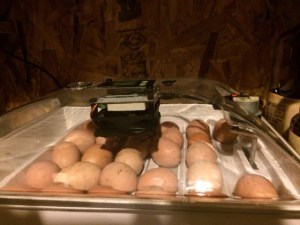
Spring was rocking and rolling.  The nine hens were producing 6-7 eggs on average and it didn’t take me long to fill all 27 slots in my incubator.  I had purchased an INCUVIEW incubator off a recommendation from TSP Podcast 1373.  I really like this incubator as it’s almost “set it and forget”.  Periodic checking the humidity and straightening the rows of eggs are all that’s needed.  The last 10 days of my 5th run went unattended while we were on vacation.

IMG_0097IMG_0082

The Delaware/Buff mix produced a 74% hatch rate.  Having never hatched chickens before we spend hours watching the chicks work their way out of the eggs.


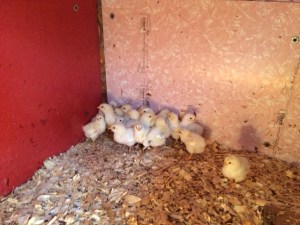
Then off to the brooder to be raised like the other meat birds.  This part of my plan went smoothly.

IMG_0098


-Jason

Dual-purpose Chickens – 2 – The flock

In fall of 2014 I decided I wanted to raise some dual-purpose chickens.  The main focus was on incubating my own birds to raise as “panfrys”, traditional meat birds frequently used in pan frying.  So I need some chickens.


After doing some research, I decided to try 2 breeds, Delaware and Buff Orpington.  I was really partial to the Delaware breed as they were initially bread to be a meet bird, but were quickly overshadowed by the current Cornish-X breeds.  However, I’d raised some Buff Orpingtons the year before.  I liked them so decided to try both.

buff Delaware

I purchased 4 hens and 2 roosters of each, along with 2 guinea hens that I also wanted for hatching eggs.  That gave me 8 new layers, plus and extra leftover Buff hen from 2014.  Having two of each rooster would allow me a chance to choose a well behaved rooster of either breed.  By spring I had decided to keep a Delaware rooster based on  having local resources to get more Buffs and the desire to really give the Delaware breed a try.


In early spring, the guineas decided to gang up on a hen.  Ganging up is apparently typical behavior for guineas, but given my limited number of hens, I was unwilling to risk losing birds so the young guineas became dinner.  I local store also started carrying guinea chicks to replace our dwindling free range flock, so I wasn’t too concerned about not having eggs for hatching.


So by the end of spring, I had my established flock, a Delaware rooster with 4 hens and 5 Buff hens.  I was ready to hatch some eggs.


-Jason

Dual-purpose Chickens – 1 – The coop

In fall of 2014 I decided I wanted to raise some dual-purpose chickens.  The main focus was on incubating my own birds to raise as “panfrys”, traditional meat birds frequently used in pan frying.  So I needed a coop.

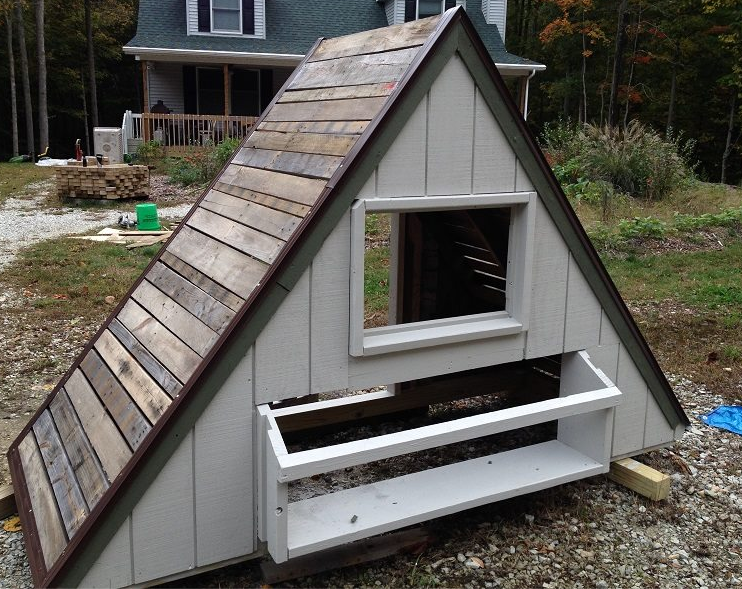
Using some pallets and leftover materials from my shed, I was able to build a nice A Frame coop for about $150.  It has 4 nesting boxes in the rear with outside access and perching poles on either end.

a-frame1a-frame2


I wanted it to be fairly easy to move, but it’s really heavy.  I guess that’s is good so it doesn’t blow over since it’s narrow.  So far, the best way to move it is by dragging it across the ground after placing a “skid” under one side.  I attached some extending  wheels from the front of an old rider mower to one end, to the left of the bucket in the picture below.  That helps to move it, but it’s still a chore best done with my compact tractor or the garden tractor.

a-frame3

For Fencing, I started out using cattle panels with chicken wire attached and used zip ties to bind them together.  However, the panels were earmarked for my chicken tractor , were heavy to move, and expensive.  I only use a couple leftover 8′ sections now.  The rest of the fencing is step-in stakes and 36″ chicken wire attached to them at the bottom and on the top clip.  So far it’s been  enough to keep the birds in place.  They get locked up at night, so I don’t need the fence to keep predators out.  It’s fairly easy to move by un-clipping each stake and rolling up the chicken wire.


-Jason