Dual-purpose Chickens – 10 – Moving the coop update

In fall of 2014 I decided I wanted to raise some dual-purpose chickens.  My focus is on a breed that lays good eggs which can be incubated to raise “panfry” broilers, pre-Cornish-Cross size meat birds.  So how about an update on how I move the coop.


I tried to keep the size of the coop minimal so that it could be easily moved.  It’s still heavy and challenging to move.  My initial thought was to add permanent retractable wheels to one end and add some sort of a trailer type tongue to the other end for lifting an pulling.  Due to the weight, the tongue never happened.  Instead I still used the retractable wheels, but also put a sledge under the opposite “tongue” end and pulled it like a sled.


This wasn’t optimal.  The coop was too heavy for the retracting mechanism I made for the wheels.  It was also hard to lift the coop to put the sledge under the other end to drag it with.  Additionally, in the spring I had to use the tractor to move it because the garden tractor would get stuck, #1 The Coop.

So  I scrapped the contraption I made for the extendable wheels and  decided to use temporarily attached wheels instead.  I scavenged two more wheels from  the front of a dead riding lawn mower.  For axils, I use 8″ bolts that are the same diameter as the original wheel axils.  I drilled holes through the coop’s 4×4 bottom frame and just slide the wheels and bolds right on.  I added some spacers between the wheel and wood to prevent rubbing.
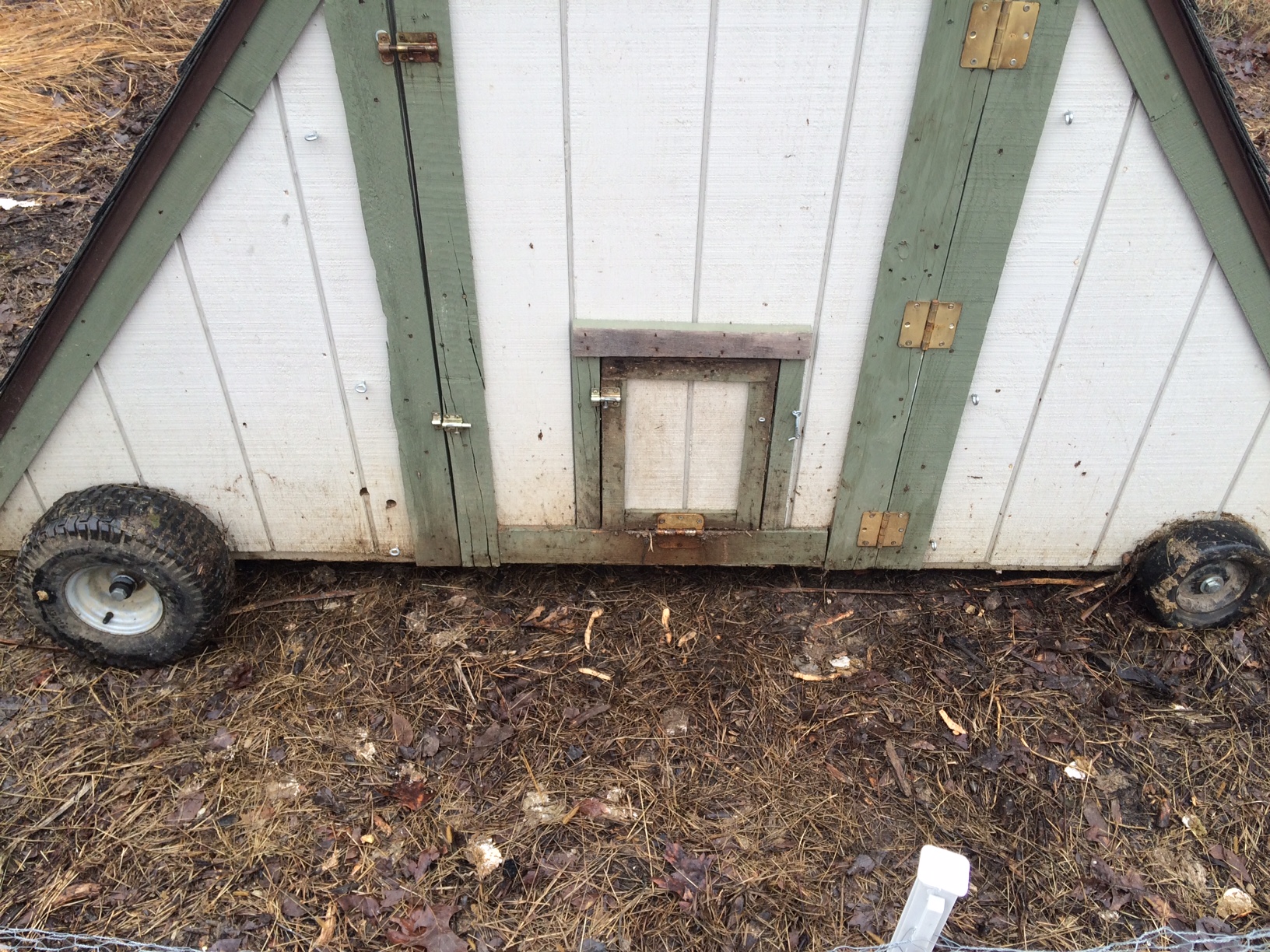
This works well.  Our winter area can get mucky, as you can probably tell by the picture to the right; however, the wheels still allow us to pull/push the coop by hand.  A small scrap piece of  chain added to one end helps us to pull or allows us to use the garden tractor for longer distance hauls.


The main downside of this method is that it requires at least two people to tip the coop and put the wheels on.  You could use a lever or jack to raise each side, but since I have two boys, it takes just a few minutes to tip the coop each way and add the wheels.

-Jason

Dual-purpose Chickens – 9 – Suplemental Light

In fall of 2014 I decided I wanted to raise some dual-purpose chickens.  My focus is on a breed that lays good eggs which can be incubated to raise “panfry” broilers, pre-Cornish-Cross size meat birds.  So, how do I provide supplemental light for consistent laying?


The 3 breeds I’ve raised so far,  Buff Orpingtons, Delaware, and Rainbows, are sensitive to the amount of “daylight” they get in relation to egg laying.  In the seasons when the days are shorter, they stop laying.  I’ve heard some breeds are not as sensitive and will keep laying, but these breeds slowed down and almost stopped on me before I added light to extend their “day”.


120Since I do want year round laying, I have to supplement the daylight with artificial light.   When the coop is near an electrical outlet, it’s easy enough to use a standard multi-time timer to power a CFL bulb in the coop.  However, we normally only bring the coop near an outlet in the cold part of winter and the birds still need supplemental light in the fall and spring when no outlets are near the coop.


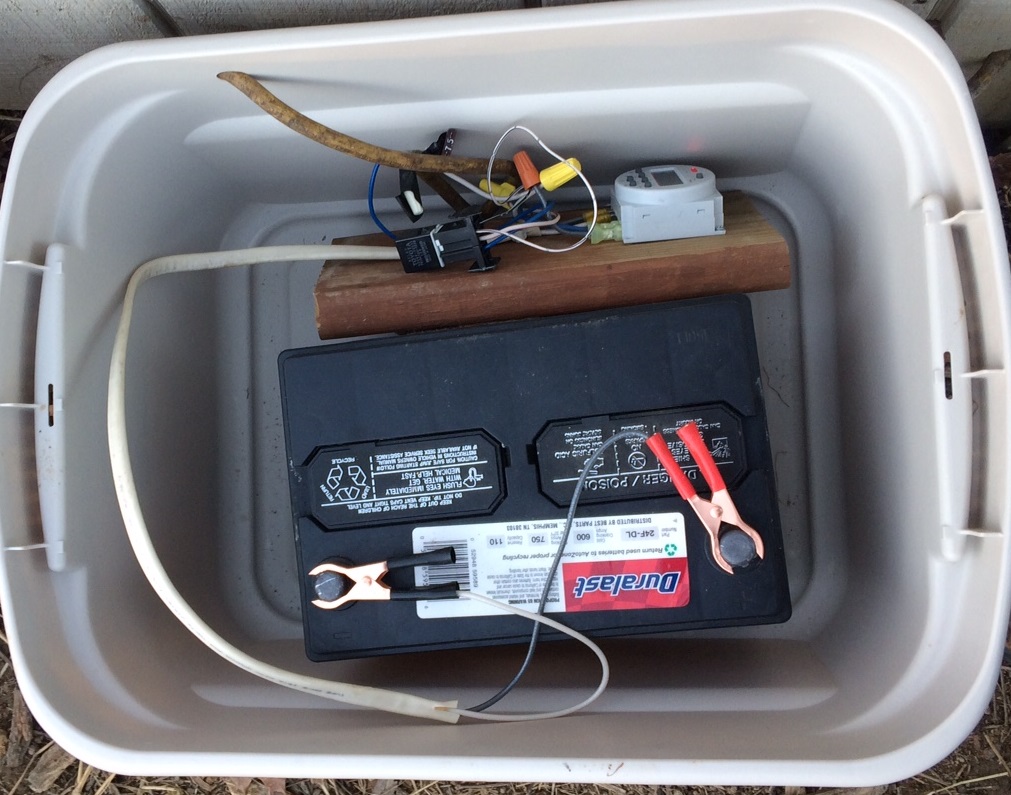
toteTo solve this, I built a DC light box.  For the light,  I ordered a 12VDC LED bulb that plugs into a standard receptacle.  I took the plug off a hanging lamp and stripped the wires to attach them to unit.  I purchased a $10 DC timer that has 16 programmable on/off times.  And I alternate deep cycle batteries for the power supply.


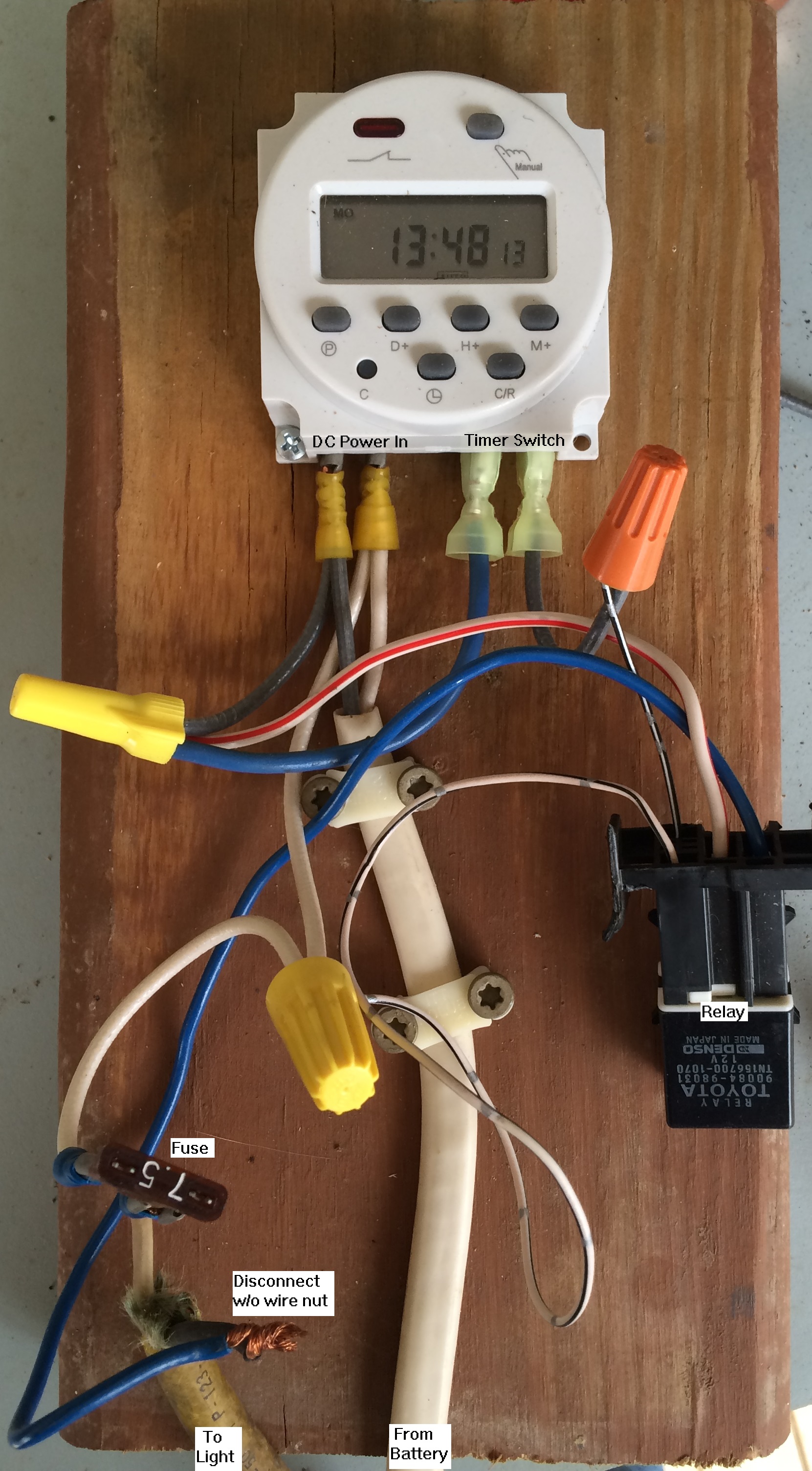
I followed the instructions to hook up the timer; however, the switch on the timer wouldn’t handle the amperage of the light if I ran it through the timer switch.  So instead, I ran a car relay off the timer switch and wired the light through the relay.  I added a fuse in as well, mainly because I already had the female spade connector cramped on and also wanted an easy disconnect in that spot anyway.  It may not be pretty, but it works.


lightTo run the light into the coop, I disconnect the lamp wire and feed it through a hole I drilled in the coop and another hole in plastic tote that houses all the electronics.

This setup works pretty good.  I have two light cycles programed, one in the morning and another one at night.   I can get at least 5 days off one battery charge running 4-6 hours of light a day.  Below are the descriptions and links to the bulbs and timer I used for your reference.

-Jason


(Pack of 2) 5w E26 LED Bulbs, 12 Volt, Warm White, Round Shape, 40w Equivalent, Solar Powered LED Bulbs, Off Grid LED Bulbs

FAVOLCANO CN101 DC 12V 16A Digital LCD Power Programmable Timer Time Switch Relay

Dual-purpose Chickens – 8 – Winter Water

In fall of 2014 I decided I wanted to raise some dual-purpose chickens.  My focus is on a breed that lays good eggs which can be incubated to raise “panfry” broilers, pre-Cornish-Cross size meat birds.  So, how do I keep the water from freezing?

One of banes of winter is frozen livestock water.  In the past, we’ve use 3 plastic 1 gallon waterers and rotated them throughout the day, bringing the frozen  ones in to thaw.  This was not an optimal solution.


I did some searching and was intrigued by an idea of using a tire to accumulate solar heat, and straw and a board inside the tire as insulation.  However, that would not work around here once the temperatures dropped well below freezing.


The idea I settled on was to use a concrete block with a light bulb inside, especially since the coop was going to be close to a power source.  It was easy to make.  Just an extension cord, a plugin light receptacle, a cooking tin, and a concrete block.  Put the cord, receptacle , and light bulb together and slid them into the concrete block.

base    light

To keep the block sitting level, either chisel a grove in the concrete block or sit the block on two pieces of wood and run the cord in-between the two pieced of wood.

Grove

And cover with a tin pan, to keep moisture away from the light.  Although I have metal waterers, I’m using the plastic ones as I think they handle the water freezing better.

waterer

I’m using a 60W bulb an it has worked pretty good.   So far this year,  most days stayed above 20 degrees , but  a few days were close to zero.  These days produced some frozen “rings” higher up in the waterer;  however, the tray stayed unfrozen and the chickens had unfrozen water to drink.    One thing to watch out for is that when the water gets close to being out, the waterer is lighter and easy to knocked off.

-Jason

Dual-purpose Chickens – 1 – The coop

In fall of 2014 I decided I wanted to raise some dual-purpose chickens.  The main focus was on incubating my own birds to raise as “panfrys”, traditional meat birds frequently used in pan frying.  So I needed a coop.

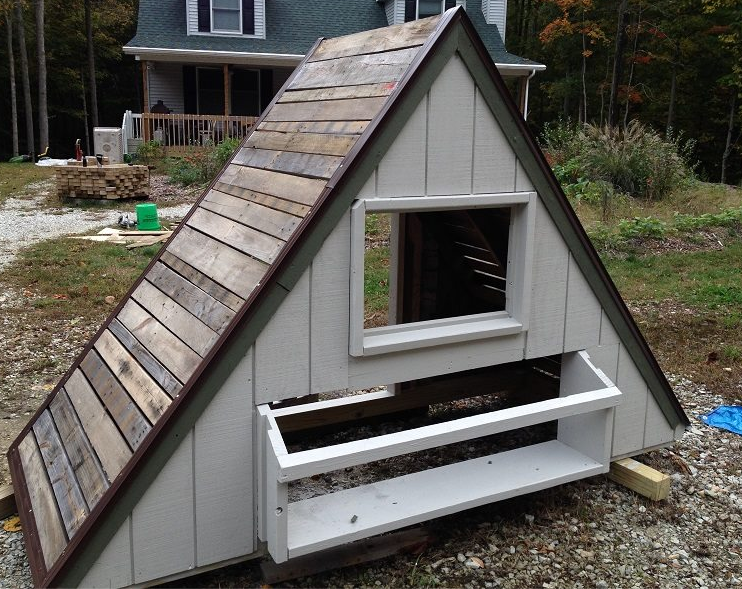
Using some pallets and leftover materials from my shed, I was able to build a nice A Frame coop for about $150.  It has 4 nesting boxes in the rear with outside access and perching poles on either end.

a-frame1a-frame2


I wanted it to be fairly easy to move, but it’s really heavy.  I guess that’s is good so it doesn’t blow over since it’s narrow.  So far, the best way to move it is by dragging it across the ground after placing a “skid” under one side.  I attached some extending  wheels from the front of an old rider mower to one end, to the left of the bucket in the picture below.  That helps to move it, but it’s still a chore best done with my compact tractor or the garden tractor.

a-frame3

For Fencing, I started out using cattle panels with chicken wire attached and used zip ties to bind them together.  However, the panels were earmarked for my chicken tractor , were heavy to move, and expensive.  I only use a couple leftover 8′ sections now.  The rest of the fencing is step-in stakes and 36″ chicken wire attached to them at the bottom and on the top clip.  So far it’s been  enough to keep the birds in place.  They get locked up at night, so I don’t need the fence to keep predators out.  It’s fairly easy to move by un-clipping each stake and rolling up the chicken wire.


-Jason

Chicken Tractor Plans – Part 2

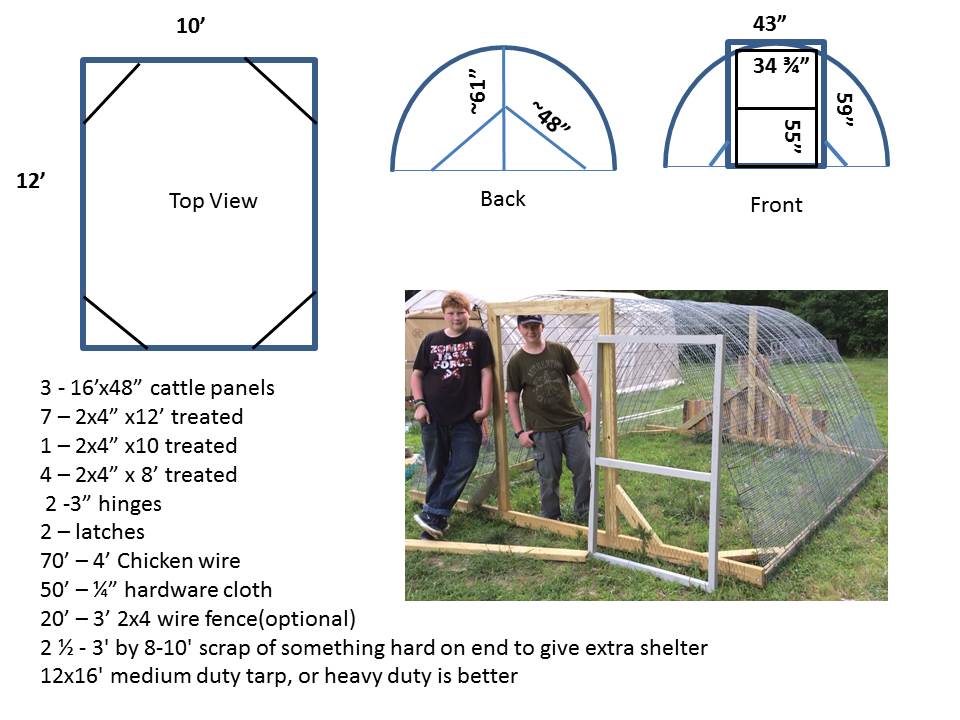
Just to add a little narrative on how I build the chicken tractors.

  1. Start with the 10×12′ frame.  The 10′ end pieces should raised slightly to help pull the tractor over clumps of grass.
  1. Add diagonal corner braces.  Not sure that size matters.
  1. Hoop 2 sections of cattle panels.  They will overlap slightly.
  1. Assemble the door.
  1. Cut the door frame and attach to base and hoop
  2. Put in rear vertical and diagonal supports.  Add something on the end bottom for additional shelter.  This will go to the most windward side, west for me.  Top is just covered by the tarp and can be raised for additional air flow.
  3. Cover the hoop with chicken wire, 3 passes of 4′.  Overlap slightly.
  1. Cover the ends & door with chicken wire.
  1. Surround the perimeter with 2′ hardware cloth (optional).  I do this to prevent predators from reaching in through the chicken wire and grabbing birds sleeping near the edge.
  1. Add 2×4 fencing to ends.  This is added to ensure K-9 type/size predators cannot force through chicken wire.
  2. Attach door and latches
  1. Cover 2/3 with tarp, wrap extra around back.


Copyright © 2018 by Jason Maples