Dual-purpose Chickens – 4 – Eggs

In fall of 201IMG_10844 I decided I wanted to raise some dual-purpose chickens.  The main focus was on incubating my own birds to raise as “panfrys”, traditional meat birds frequently used in pan frying.  Now I want eggs.


In between my incubation sessions, we were getting 6-7 eggs average a day from the 9 hens.  We had built up  a rotation of almost 8 dozen eggs in the fridge when we started having issues.


First I noticed some eggs were broken.  I determined it was a chicken pecking eggs, but which one?  While I was trying to figure out how to catch the egg eater, first one, then two of the Buff Orpington hens went broody on me.  At first they were in the nesting boxes, but as I kept kicking them out of those, they took up corners in the coop.  I managed to dissuade one of them by continually kicking her out, but the other was to stubborn.


In the mean time, I thought I had found my egg eater.  I saw a Buff running around with a broken egg shell.  I separated her, but by now between the broody hens taking all the eggs and the egg eater we were only getting 1-2 eggs a day.  This went on for almost 6 weeks while I “studied” the birds and waited for a chicken tractor to be freed so I could start isolating the birds to get to the bottom of what was going on.


The Buff I separated wash sharing the tractor with my dual-purpose meat birds.  However, she was rejoined the flock after two weeks as the loss of eggs had not lessoned and she started laying in the tractor without pecking the eggs.  The birds that were in the tractor with her graduated, but we restocked the tractor with Brother’s M chickens and I did not want to the layer hens with the Brother’s meat birds.  Finally we emptied the chicken tractors; however, we were leaving for vacation in a week.  I didn’t want to complicate things for my caretaker, so almost two months passed with little to no eggs.


When we returned from a vacation, I immediately separated the Delaware and Buffs by putting the Buffs in an empty tractor.  Within a week the buffs started laying 2-3 eggs again while the Delawares produced none.  So I started introducing Delaware hens with the Buffs to identify the egg eater.  The first one I introduced ran past me and started pecking the Buff eggs as I was trying to gather them.  Found her!  The other two were introduced 3 days apart and we did not loose any more eggs.


But now, I was losing daylight and the birds were not laying well.  I moved the coop up by the house and installed a light on a timer.  Production picked up, until… more pecked egg.  This time I noticed a Delaware hanging out in the coop and separated her.  No missing eggs for a week.  Then …. More pecked eggs.  I took the third and last Delaware out of the flock, one had disappeared during the summer, and now had just 5 Buffs.


Months later and still no pecked eggs.  The 5 Buffs are producing an average of 3 eggs a day.


-Jason

Dual-purpose Chickens – 3 – Incubation

In fall of 2014 I decided I wanted to raise some dual-purpose chickens.  The main focus was on incubating my own birds to raise as “panfrys”, traditional meat birds frequently used in pan frying.  So let’s do some hatching.


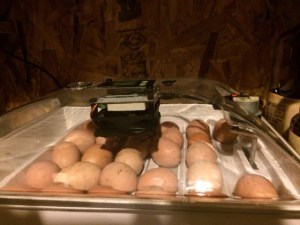
Spring was rocking and rolling.  The nine hens were producing 6-7 eggs on average and it didn’t take me long to fill all 27 slots in my incubator.  I had purchased an INCUVIEW incubator off a recommendation from TSP Podcast 1373.  I really like this incubator as it’s almost “set it and forget”.  Periodic checking the humidity and straightening the rows of eggs are all that’s needed.  The last 10 days of my 5th run went unattended while we were on vacation.

IMG_0097IMG_0082

The Delaware/Buff mix produced a 74% hatch rate.  Having never hatched chickens before we spend hours watching the chicks work their way out of the eggs.


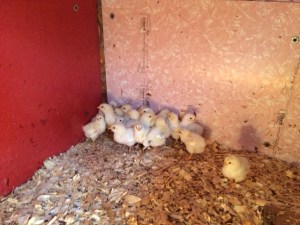
Then off to the brooder to be raised like the other meat birds.  This part of my plan went smoothly.

IMG_0098


-Jason

Dual-purpose Chickens – 2 – The flock

In fall of 2014 I decided I wanted to raise some dual-purpose chickens.  The main focus was on incubating my own birds to raise as “panfrys”, traditional meat birds frequently used in pan frying.  So I need some chickens.


After doing some research, I decided to try 2 breeds, Delaware and Buff Orpington.  I was really partial to the Delaware breed as they were initially bread to be a meet bird, but were quickly overshadowed by the current Cornish-X breeds.  However, I’d raised some Buff Orpingtons the year before.  I liked them so decided to try both.

buff Delaware

I purchased 4 hens and 2 roosters of each, along with 2 guinea hens that I also wanted for hatching eggs.  That gave me 8 new layers, plus and extra leftover Buff hen from 2014.  Having two of each rooster would allow me a chance to choose a well behaved rooster of either breed.  By spring I had decided to keep a Delaware rooster based on  having local resources to get more Buffs and the desire to really give the Delaware breed a try.


In early spring, the guineas decided to gang up on a hen.  Ganging up is apparently typical behavior for guineas, but given my limited number of hens, I was unwilling to risk losing birds so the young guineas became dinner.  I local store also started carrying guinea chicks to replace our dwindling free range flock, so I wasn’t too concerned about not having eggs for hatching.


So by the end of spring, I had my established flock, a Delaware rooster with 4 hens and 5 Buff hens.  I was ready to hatch some eggs.


-Jason

Dual-purpose Chickens – 1 – The coop

In fall of 2014 I decided I wanted to raise some dual-purpose chickens.  The main focus was on incubating my own birds to raise as “panfrys”, traditional meat birds frequently used in pan frying.  So I needed a coop.

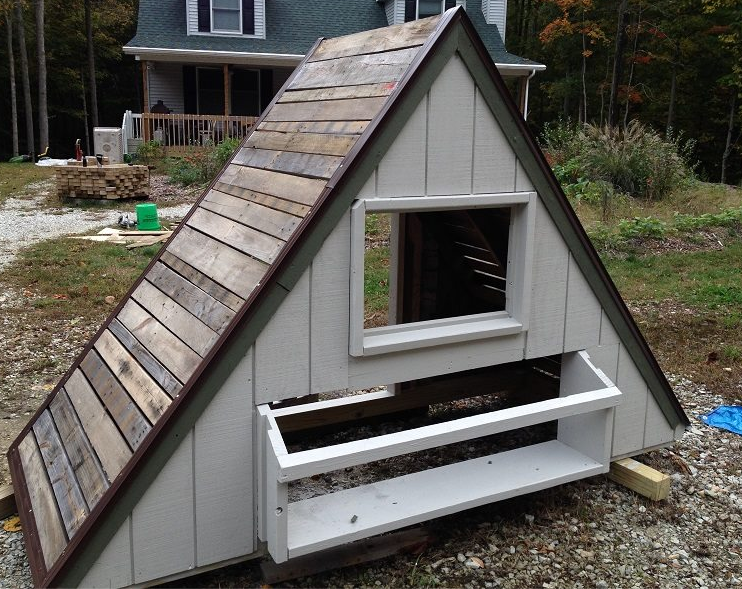
Using some pallets and leftover materials from my shed, I was able to build a nice A Frame coop for about $150.  It has 4 nesting boxes in the rear with outside access and perching poles on either end.

a-frame1a-frame2


I wanted it to be fairly easy to move, but it’s really heavy.  I guess that’s is good so it doesn’t blow over since it’s narrow.  So far, the best way to move it is by dragging it across the ground after placing a “skid” under one side.  I attached some extending  wheels from the front of an old rider mower to one end, to the left of the bucket in the picture below.  That helps to move it, but it’s still a chore best done with my compact tractor or the garden tractor.

a-frame3

For Fencing, I started out using cattle panels with chicken wire attached and used zip ties to bind them together.  However, the panels were earmarked for my chicken tractor , were heavy to move, and expensive.  I only use a couple leftover 8′ sections now.  The rest of the fencing is step-in stakes and 36″ chicken wire attached to them at the bottom and on the top clip.  So far it’s been  enough to keep the birds in place.  They get locked up at night, so I don’t need the fence to keep predators out.  It’s fairly easy to move by un-clipping each stake and rolling up the chicken wire.


-Jason

It’s about that time…

It’s about that time and we will be processing the chickens over the next couple of weeks.  These birds are averaging closer to 6 – 7 lbs this run.  Over achievers!   

IMG_0861

For those who have pre-ordered we will be contacting you shortly to arrange pick-up.

For those of you who have not pre-ordered – it’s not too late.  There is still time to place an order.  Just send us an email, brothersM.poultry@gmail.com, and we’ll get you taken care of.

A special thanks to everyone for helping make Brothers M. Poultry a successful venture.

Chicken Tractor Plans – Part 2

Just to add a little narrative on how I build the chicken tractors.

  1. Start with the 10×12′ frame.  The 10′ end pieces should raised slightly to help pull the tractor over clumps of grass.
  1. Add diagonal corner braces.  Not sure that size matters.
  1. Hoop 2 sections of cattle panels.  They will overlap slightly.
  1. Assemble the door.
  1. Cut the door frame and attach to base and hoop
  2. Put in rear vertical and diagonal supports.  Add something on the end bottom for additional shelter.  This will go to the most windward side, west for me.  Top is just covered by the tarp and can be raised for additional air flow.
  3. Cover the hoop with chicken wire, 3 passes of 4′.  Overlap slightly.
  1. Cover the ends & door with chicken wire.
  1. Surround the perimeter with 2′ hardware cloth (optional).  I do this to prevent predators from reaching in through the chicken wire and grabbing birds sleeping near the edge.
  1. Add 2×4 fencing to ends.  This is added to ensure K-9 type/size predators cannot force through chicken wire.
  2. Attach door and latches
  1. Cover 2/3 with tarp, wrap extra around back.


Copyright © 2018 by Jason Maples


Brothers M.

When things feel right.


I’ve been considering taking raising chickens to the next level, raising and selling pastured non-GMO chickens.  For the past year I’ve raised 5 batches of chickens using my local feed mill grain.  I processed some of these, but had most processed for me; all were for immediate family.  Late last week I checked to see if I could get some chickens to raise for sell.  The breed I wanted was out of stock.


This week, off a whim, I checked and my breed was back in stock.  That night my boys came to me and asked how they could raise money for the Scout Jamboree in 2017.  I made them a business proposition contingent on getting processing lined up and non-GMO feed.  In the  next two days everything fell into place and Brothers M. Poultry was born.