If you missed our CSA in the spring, there’s good news. We’re opening our CSA for the month of July, 2017.
Hurry, slots are limited. If you miss this opportunity, our CSA will not be available again until 2018.
Here’s a link to our CSA Page.
If you missed our CSA in the spring, there’s good news. We’re opening our CSA for the month of July, 2017.
Hurry, slots are limited. If you miss this opportunity, our CSA will not be available again until 2018.
Here’s a link to our CSA Page.
I had big dreams; I still do. When we moved out to the country 3-4 years ago, I had lots of plans, most centered around pemaculture. If you followed my FB posts back then, you saw lots of swales, hundreds of trees and bushes, and lot of other “gardening” things. Well priorities happened and several of the projects I started have been left to the wild.
 This year I’m taking some of them back. Not that I really have any extra time, but it was looking like this was the pivotal year for either doing something or losing the effort and money I previously invested in them.
Here’s the brush pile from the projects I’m reclaiming. It’s 6′ tall in this picture and I added a couple more feet after that.
And here are the projects that I’m reclaiming.
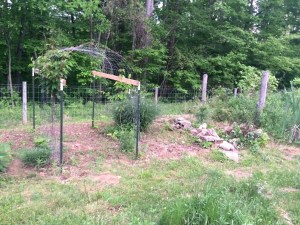 #1 is my Kiwi vines. During our year of house building, this area was a nursery for all the plants I brought with us. I had it fenced in to keep deer out and the kiwis intertwined in the fence. Luckily I planted the plants far enough apart that this year I turned it into an arbor using sections of the fence. When I cleared out the overgrowth, I kept the decorative grasses still there from the nursery and I even found the third kiwi plant that I though was lost. So I still have my male and two female vines.
 #2 is the frog pond with the honeyberry swale. There are 5 honeyberry bushes I’m reclaiming as well as comfrey plants and some hostas. Still have some work, but the thorn bushes are out now.
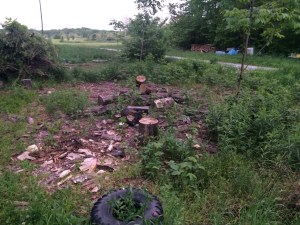 #3 is just where I had a pile of about 15 logs. The boys helped me cut, split, and stack all the logs. There were quite a few volunteer trees growing here between the logs, some almost 16′ tall. As soon as we clear up the junk logs and scraps, I’ll be able to mow this area and get it ready as pasture for the laying hens.
I didn’t get completely finished tonight. I had to stop due to loss of light and injury. This thorn doesn’t look like much, but trust me, it really hurts to move your knuckle when there’s a thorn stuck in it. It’s still sore as I type.

Looking forward to the bonfire tomorrow when I get rid of this brush pile.
-Jason
In fall of 2014 I decided I wanted to raise some dual-purpose chickens. My focus is on a breed that lays good eggs which can be incubated to raise “panfry” broilers, pre-Cornish-Cross size meat birds. So, how do I provide supplemental light for consistent laying?
The 3 breeds I’ve raised so far, Buff Orpingtons, Delaware, and Rainbows, are sensitive to the amount of “daylight” they get in relation to egg laying. In the seasons when the days are shorter, they stop laying. I’ve heard some breeds are not as sensitive and will keep laying, but these breeds slowed down and almost stopped on me before I added light to extend their “day”.
 Since I do want year round laying, I have to supplement the daylight with artificial light. When the coop is near an electrical outlet, it’s easy enough to use a standard multi-time timer to power a CFL bulb in the coop. However, we normally only bring the coop near an outlet in the cold part of winter and the birds still need supplemental light in the fall and spring when no outlets are near the coop.
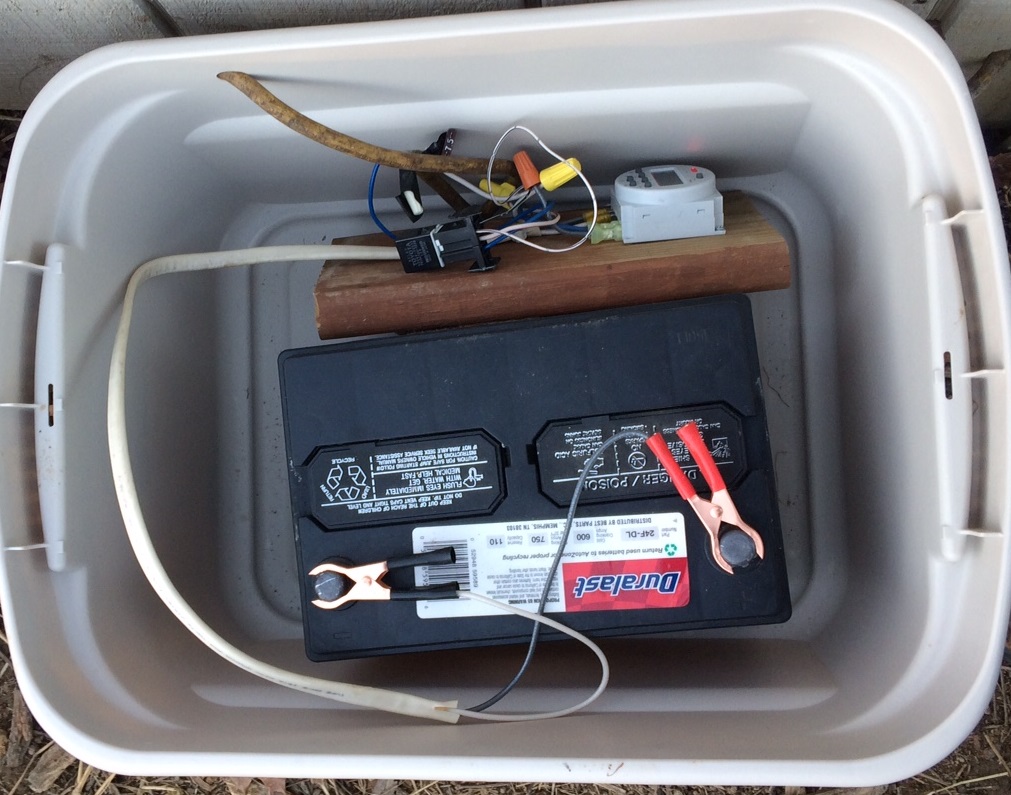 To solve this, I built a DC light box. For the light, I ordered a 12VDC LED bulb that plugs into a standard receptacle. I took the plug off a hanging lamp and stripped the wires to attach them to unit. I purchased a $10 DC timer that has 16 programmable on/off times. And I alternate deep cycle batteries for the power supply.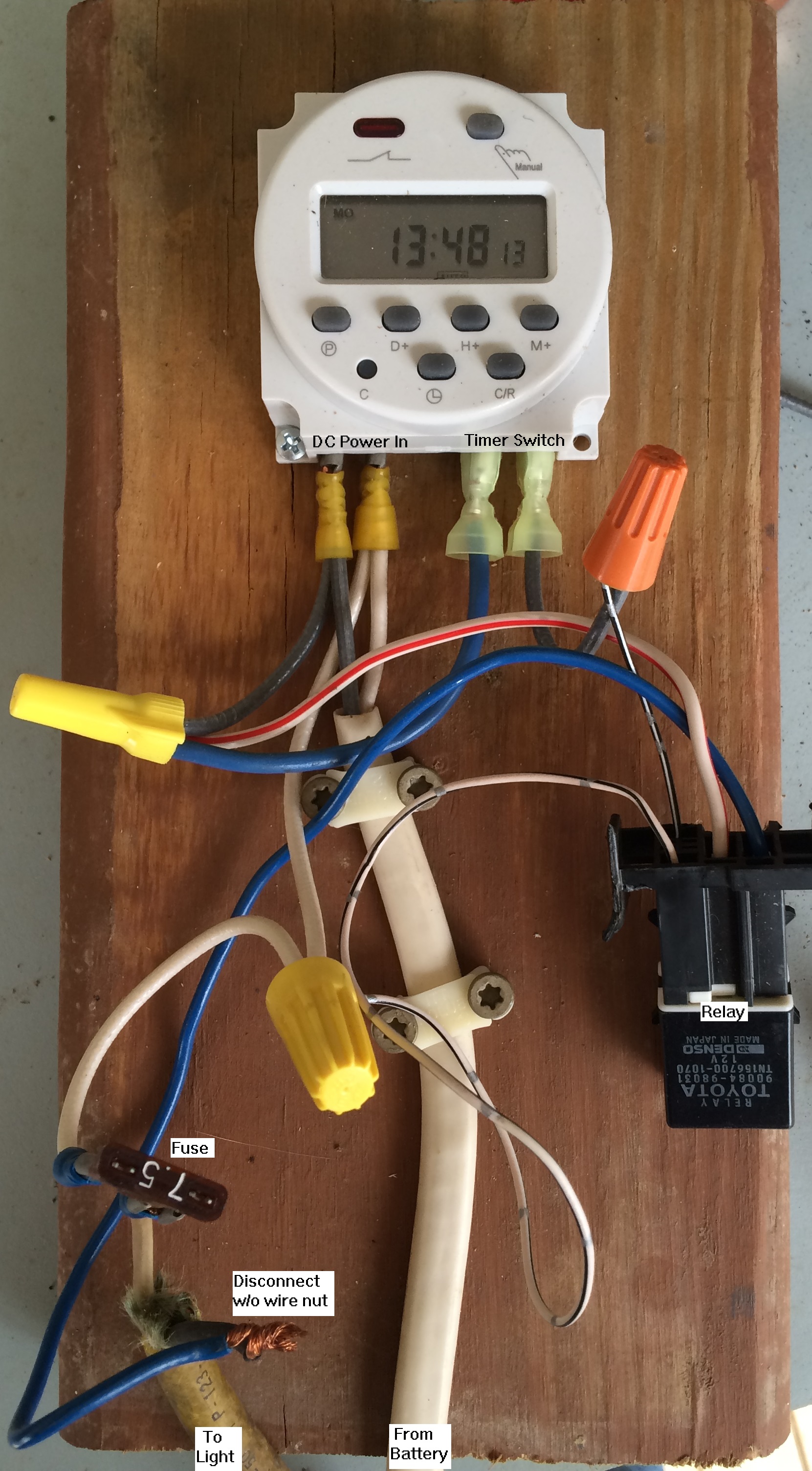
I followed the instructions to hook up the timer; however, the switch on the timer wouldn’t handle the amperage of the light if I ran it through the timer switch. So instead, I ran a car relay off the timer switch and wired the light through the relay. I added a fuse in as well, mainly because I already had the female spade connector cramped on and also wanted an easy disconnect in that spot anyway. It may not be pretty, but it works.
 To run the light into the coop, I disconnect the lamp wire and feed it through a hole I drilled in the coop and another hole in plastic tote that houses all the electronics.
This setup works pretty good. I have two light cycles programed, one in the morning and another one at night. I can get at least 5 days off one battery charge running 4-6 hours of light a day. Below are the descriptions and links to the bulbs and timer I used for your reference.
-Jason
FAVOLCANO CN101 DC 12V 16A Digital LCD Power Programmable Timer Time Switch Relay
It’s Here!
We are officially kicking off our 2017 season. We will have frozen chickens available starting May 27; CSAs will have an opportunity to pickup fresh chickens the previous Saturday. Below are some of the highlights. Visit our Pricing Page for more details.
Pricing for 2017
• $4.00/lb for whole frozen chickens.
○ Average weight 4-5 lbs
• CSA packages – Our best offer
○ Ends May 1st or when all our CSA slots are full.
• Bulk purchase discounts
○ 5 chickens = 4%
○ 10 chickens = 6%
○ 15 chickens = 8%
○ 20 chickens = 10%
We’ll primarily be selling through the Farmers Markets
• Seymour Farmers Market – Saturdays, May 27 – until sold out for 2017
•• Westport Farmers Market – TBD for 2017
Why did we do a separate CSA and bulk discount?
It all comes down to what is Community Supported Agriculture(CSA). Last year was the first year for our CSA and we ended up giving our CSA pricing to everyone wanting to place bulk orders. We did this because we didn’t have a bulk discount. It was a compromise, but I knew this year we needed to change it in order to get back to the true CSA spirt.
The spirit of CSA is not about the discount. CSA is about supporting local agriculture because you realize the value of locally grown food, believe in supporting community businesses, or you want to support someone growing high quality food. While the reasons are your own, it really boils down to you supporting a cause. And one I think is a good one, if I didn’t we wouldn’t be doing this.
We value our CSA relationships. Your commitment helps shoulder our burden and tells us that what we do matters. It’s hard to explain how much that means to us, but we’ve tried to express it by returning to our CSA supporters the best value we can.
We’re looking forward to a great year and each of you are the ones who help make it happen. We hope you like and share our posts and if you’re buying chicken to give us the chance to earn your loyalty. Thank you.
The 2017 season is upon us and we’ll be announcing the schedule and pricing in the next couple days!
We’ve enjoyed some downtime over the winter, especially the holidays, and we hope you enjoyed them too. It’s going to be a busy year for our family including the long awaited Boy Scout Jamboree, which is why we’re selling chickens.
Before we officially announce the 2017 season, we’re finalizing the schedule and updating our offerings. I can tell you now that our base price of $4/lb. will not be increased; however, we are adding some options.
In the mean time, I’ve posted a new blog on Dual-purpose Chickens. There will be more of these to come.
We thank everyone for all your past support and look forward to a great season.
In fall of 2014 I decided I wanted to raise some dual-purpose chickens. My focus is on a breed that lays good eggs which can be incubated to raise “panfry” broilers, pre-Cornish-Cross size meat birds. So, how do I keep the water from freezing?
One of banes of winter is frozen livestock water. In the past, we’ve use 3 plastic 1 gallon waterers and rotated them throughout the day, bringing the frozen ones in to thaw. This was not an optimal solution.
I did some searching and was intrigued by an idea of using a tire to accumulate solar heat, and straw and a board inside the tire as insulation. However, that would not work around here once the temperatures dropped well below freezing.
The idea I settled on was to use a concrete block with a light bulb inside, especially since the coop was going to be close to a power source. It was easy to make. Just an extension cord, a plugin light receptacle, a cooking tin, and a concrete block. Put the cord, receptacle , and light bulb together and slid them into the concrete block.


To keep the block sitting level, either chisel a grove in the concrete block or sit the block on two pieces of wood and run the cord in-between the two pieced of wood.

And cover with a tin pan, to keep moisture away from the light. Although I have metal waterers, I’m using the plastic ones as I think they handle the water freezing better.

I’m using a 60W bulb an it has worked pretty good. So far this year, most days stayed above 20 degrees , but a few days were close to zero. These days produced some frozen “rings” higher up in the waterer; however, the tray stayed unfrozen and the chickens had unfrozen water to drink. One thing to watch out for is that when the water gets close to being out, the waterer is lighter and easy to knocked off.
-Jason
It’s official. Both boys are signed up for Jamboree next year. Now the pressure’s on for them to “earn their keep”. Thanks to the 2015 sales the boys have or will pay for several weekend campouts and summer camp. We’re looking forward to 2016 and beyond…
-Jason

|
July 19-28, 2017 Live Scouting’s Adventure |
|
Your application has been approved by Hoosier Trails Council to attend the 2017 National Scout Jamboree as part of their council contingent.
If you should have any questions about payments or anything else, please contact your Council directly.
We look forward to seeing you in July 2017!
Thank you, Jamboree Registrar |
 In fall of 2014 I decided I wanted to raise some dual-purpose chickens. The main focus was on incubating my own birds to raise as “panfrys”, traditional meat birds frequently used in pan frying. So where do I go from here?
So the questions I still have are what breed(s) do I want to continue working with and what size flock do I want.
For the breed, I’m not done trying different breeds. I’m still looking for meet and eggs. I’ve read that modern breeders are mostly focused on ‘show bird’ traits of the bird’s breed, and not on the functionality of the bird, such as egg production and size. So, this year, I’m going to try buying my dual purpose birds from the hatchery I use for the meet birds. The breed is called Rainbow and no two birds look alike.
As for the size of the flock, I’m still undecided for the long run. A lot depends on where I want to go with these birds. I think this year, I’ll stick to my a flock of 9-10 plus a rooster. That way I won’t need to build a bigger coop.
The flock size brings us to the main question we get asked. “are you going to sell eggs”. The answer is I don’t know. It’s a possibility; however, this year it’s definitely going to be along the lines of a “when available” adjunct to us selling our chickens. If we build a bigger coop, incorporate some egg only breed(s), and figure out some portable lighting for the coop, I’ll look more seriously at selling eggs in the future.
-Jason
In fall of 2014 I decided I wanted to raise some dual-purpose chickens. The main focus was on incubating my own birds to raise as “panfrys”, traditional meat birds frequently used in pan frying. So how did 2015 go?
Overall I got what I expected. Layers producing at around 60% egg to chick ratio and broilers weighed 3lbs dressed; both good foragers. The main learning point of this experiment was the evaluation of breeds.
My Delaware chickens caused me much distress. It seemed they all ate eggs. Because of this, it was hard to judge egg production. I’m going to give them the benefit of the doubt and say it was equal, even though my gut tells me it was less. And the final straw was a psychotic rooster.
I am pleased with the Buff Orpington hens. To date, I’ve not found them to be egg eaters and they have a steady egg production at about 60%. The one drawback is that I’ve still not been completely successful in breaking my broody hen. That would be a bonus if I didn’t have an incubator, but since I do, it’s just a nuisance.
Overall, I see why Buff Orpington is a more popular homestead breed. I’ve seen several people praise the Delaware breed, which is why I tried them, but my experience wasn’t favorable. Of the two, I choose Buffs.
-Jason
 Maples Miscellany