Brothers M. Mondays – A new post each Monday until the 2018 market season starts on 5/26.
Pasturing is an important part of producing such high quality, good tasking chicken. We get them onto pasture as early is safe for the chickens to maximize their naturally grown experience. Enjoy the video of the kids moving the chickens from the brooder into the pasture.
Brothers M. Mondays – A new post each Monday until the 2018 market season starts on 5/26.
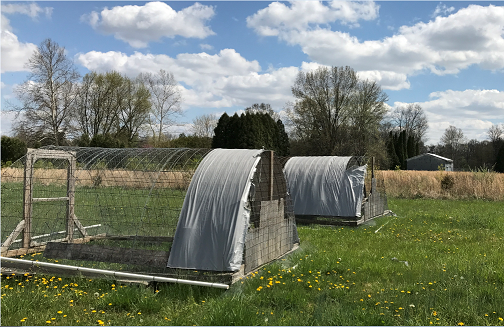
Each year the chicken tractor tarps need to be replaced. These are an important part of the tractor providing shelter from rain and storms as well as shade. Therefore they need to be in good shape each year.
Brothers M. Mondays – A new post each Monday until the 2018 market season starts on 5/26.
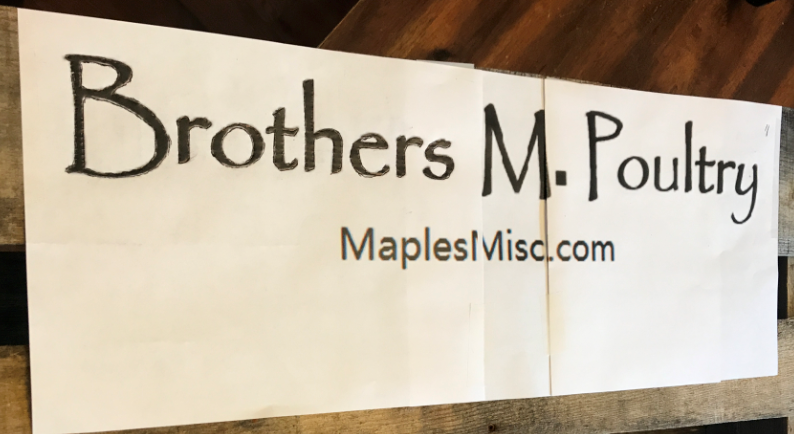
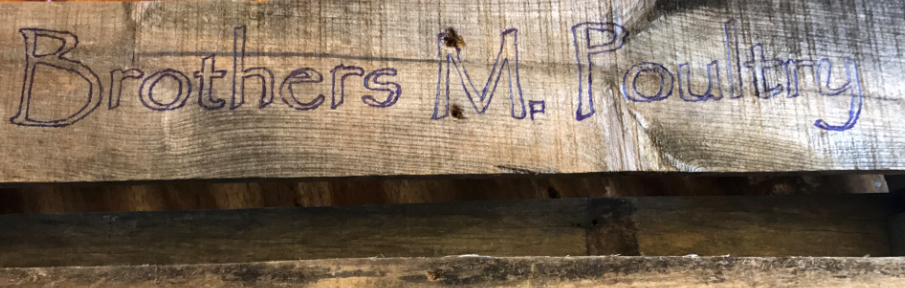
We needed new signs for the farmers markets. Samantha offered her talents to help with the creation. She likes painting and does a good job, so filling in the tracing lines was a snap for her.
The signs are made of recycled pallet wood. They feature a rope handle and space in the middle to carry most of our farmers market materials.
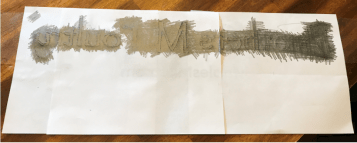
We used a home made carbon paper method to transfer the outline to the boards for painting. Basically cover the back side with pencil graphite then traced real hard.
Last year I had to add detail to my parts list, which lead me to create the below outline and part list. If you’re familiar with carpentry, you should be able to take this blog and build a very sturdy and versatile chicken tractor. Add this post to the basic diagrams in my earlier two posts, part 1 and part 2, and enjoy.
That’s not all. This outline inspired me to write a 75+ page step by step how-to guide with illustrations, additional information, and personal experiences. If you would like this detailed how-to guide,CLICK HERE.
As always, thank you for checking us out and all your support by liking and sharing.
Supply List with details.
Main Items
3 – 16’x50” cattle/feedlot panels
Form the “hoop” structure Slightly overlapped
May want to cut one rung off end to shorten it so tarp can be stapled wood base easier. Tarps come a little short because the measurements are raw not finished.
5 – 2x4x12 treated
2 – 12′ base sides
2 – Cut 10′ base ends – 2′ extras become door diagonal supports
1 – Cut 43″ for door frame top & cut 2 – 50″ sections for back diagonals
1 – 2x4x10
1 – Cut 2 – 59″ door frame sides
4 – 2x4x8 treated (3 if using 2×2 back upright)
1 – cut into 2′ lengths for corner braces for bottom frame
2 – Rip in half to use for door
Or use 4 2x2x8 furring strips, but should stain them if not treated
Gives 4 2x2x8
1 – cut into 55″ and 31.5″ for side and top of door
1 – cut into 55″ and 31.5″ for side and bottom of door
1 – cut into 31.5 for middle brace on door
1 – (optional) cut 61″ for back upright instead of using a 2×4
1 – Cut 61″ for back upright
75’ – 4’ Chicken wire
50′ for 3 passes over the cattle pannels
20′ for the ends
50’ – 2′ hardware cloth, ¼” mesh
Perimeter of entire house. Critter protection.
20’ – 3’ 2×4 wire fence
Put over ends of coop for K-9 protection
2 ½ – 3′ x 5-7′ scrap for back end weather board to give extra shelter
Should be fairly light
Thin pallet wood, what I used.
Sheet of tin roof
1/4-1/2″ plywood or OSB
12×16′ medium duty tarp, or heavy duty if you prefer. Note the extra gets wrapped around the ends
2 – 3” hinges
2 – bolt latches
1 – handle
1 – large bag of zip ties. Used to fasten all the chicken wire, hardware cloth, fence, and cattle panels together. So you want plenty.
Misc. Hardware
2 – 3” hinges
2 – bolt latches
1 – handle
24 – 3-3.5″ Lag screws. To assemble base, including corner supports
~26 – 3″ deck screws. To assemble door & frame and back upright and diagonals
1/2-3/4″ Staples for staple gun
~32 – 1 3/4″ Galvanized Fence staples. To attach the cattle panels to the base and anchor the door and back upright.
Fasteners to attach the back weather break that won’t penetrate the 2×4 it’s going into.
1 1/4 – 1 1/2 16GA staples (pneumatic stapler)
1 1/2 – 1 3/4″ screw (Better than hand nails)
3d-4d nail (d=penny)
12’x16′ medium or heavy duty tarp.
Optional Apron
Ends
25’ – 2′ ¼” hardware cloth
Will actually use approximately 12′, 1′ overlap on the ends.
2 – 1 1/4″ x 10′ PVC pipe
For front and rear aprons
Sides
25’ – 2′ ¼” hardware cloth (Can us e leftover from front and back apron if only 12′ was used for ends)
Will use approximately 13-14′. Thirteen feet will give a 6″ overlap of the front and back apron while using just 1- 25′ roll of hardware cloth.
3 – 1 1/4″ x 10′ PVC pipe
2 – 1 1/4 PVC coupling
How I build the chicken tractors.
Start with the 10×12′ frame. The 10′ end pieces should be raised about an inch to help pull the tractor over clumps of grass.
Add diagonal corner braces.
Hoop 3 sections of cattle panels. They will overlap slightly. Nail them to the base and wire tie hoop sections together
Assemble the door.
Cut the door frame and attach to base and hoop with screws and fence nails.
Cut and assemble the door. I wait to attach it after I’ve stapled the chicken wire to the door.
Put in rear vertical attaching the top to the hoop with fence nails. Attach the diagonal supports.
Add your end material for additional shelter. Note: This side of the tractor will go to the most windward side, west for me. The upper section is just covered by the tarp and can be raised for additional air flow. (don’t attach tarp yet)
Cover the hoop with chicken wire, 3 passes of 4′. Overlap slightly. Staple to wood frame and zip tie together and to the hoop. I use a pneumatic staple gun with 5/8 staples, but a hand stapler should work fine, especially if you use a hammer afterwards to ensure they are tight.
Note: If you don’t have a continuous 75′, such as two rolls of 50′ and 25′, plan it out first. Cover the hoop, then back. Save the front (door end) for last as it uses 3 smaller pieces.
Cover the back and front sections and door with chicken wire.
Note: the bottom 2′ will be hardware cloth and the upper section will be chicken wire.
If you purchased 75′ you should be able to piece together the entire door and sides if you prefer. I do the front and rear end across bottom with hardware cloth, then the piece in the tops with the chicken wire.
Surround the perimeter with 2′ hardware cloth. I added this to stop predators from reaching in through the chicken wire and grabbing birds sleeping near the edge.
Cover the back bottom 2′ that isn’t protected by your end material with Hardware cloth. Optionally you can cover the entire back for extra protection depending on what back end material you used.
Start from the back and move to the front.
Note: If you don’t have 50′ continuous role, plan you’re cuts accordingly. IE, for 2 25′ roles, start in the back and wrap up to the door using one role for each side. Then do the door.
Add 2×4 fencing to ends. This is added for K-9/coyote protection. Three foot doesn’t make it impossible for a K-9 to get over it, but that height with the chicken wire too makes for pretty good protection. So far we’ve survived 2 K-9 attacks.
Note: Use a type/size predators cannot force through. I use 2×4 3′ 14 gauge welded wire.
Attach door with hinges and add latches and handle.
Cover 2/3 of the hoop with the tarp, wrap extra around back. Staple the tarp to the wood base and wire tie the eyelets to the hoop.
Note: My medium duty tarps last one season. I remove and re-add each season.
BONUS: Add an apron to the front and back for added protection. You can also do the sides.
Staple 12-14′ of 2′ hardware cloth to the front and back base, leaving 1-2′ of overlap past the tractor. I try to leave it a little loose so it has a little “hinge” to it. I don’t know that it’s required.
Wire tie a PVC pipe to opposite end of the hardware cloth for weight.
Note: If you cut the PVC end of the hardware cloth and bend the points down, it’s more of a deterrent for critters that might burrow under.
May seems far away, but we’ve already finished our planning and scheduling for the year. Now is time to open up the CSA orders.
Our CSA is now open.
CSA orders are available now until all the slots are full or May 1st, whichever comes first. We’re happy to announce that our prices are staying the same again this year; no price increases. However, we have made some minor changes in the scheduling.
We’ll be doing one larger batch of chickens in the spring instead of the two smaller spring & fall batches as we did last year. This mean only one pickup day for CSA orders. Based on last year’s pick-up schedules this should work out well and it helps us give you the best prices by keeping our costs down. If this does impact you, please provide us your feedback.
One spring batch means you have 2 dates to choose from to pick up your frozen CSA orders, June 2nd or 9th.
You can still choose to pick up your CSA fresh at our homestead, just arrange a time with us in the evening on June 1st or 8th.
Our quality has not changed. We’re still raising the same tasty pastured Non-GMO chickens we’re known for, so don’t miss out and order yours today.
Look for a new face at the farmers market. Joseph is stepping aside to give Samantha the opportunity to work with Matthew raising and selling chickens.
We’ll continue to be at the Seymour and North Vernon during the normal Farmers Markets season. We try to be in Seymour every week and North Vernon at least twice a month, usually the first and 3rd Saturdays, until the chicken runs out.
It’s Here!
We are officially kicking off our 2017 season. We will have frozen chickens available starting May 27; CSAs will have an opportunity to pickup fresh chickens the previous Saturday. Below are some of the highlights. Visit our Pricing Page for more details.
Pricing for 2017
• $4.00/lb for whole frozen chickens.
○ Average weight 4-5 lbs
• CSA packages – Our best offer
○ Ends May 1st or when all our CSA slots are full.
• Bulk purchase discounts
○ 5 chickens = 4%
○ 10 chickens = 6%
○ 15 chickens = 8%
○ 20 chickens = 10%
We’ll primarily be selling through the Farmers Markets
• Seymour Farmers Market – Saturdays, May 27 – until sold out for 2017
•• Westport Farmers Market – TBD for 2017
Why did we do a separate CSA and bulk discount?
It all comes down to what is Community Supported Agriculture(CSA). Last year was the first year for our CSA and we ended up giving our CSA pricing to everyone wanting to place bulk orders. We did this because we didn’t have a bulk discount. It was a compromise, but I knew this year we needed to change it in order to get back to the true CSA spirt.
The spirit of CSA is not about the discount. CSA is about supporting local agriculture because you realize the value of locally grown food, believe in supporting community businesses, or you want to support someone growing high quality food. While the reasons are your own, it really boils down to you supporting a cause. And one I think is a good one, if I didn’t we wouldn’t be doing this.
We value our CSA relationships. Your commitment helps shoulder our burden and tells us that what we do matters. It’s hard to explain how much that means to us, but we’ve tried to express it by returning to our CSA supporters the best value we can.
We’re looking forward to a great year and each of you are the ones who help make it happen. We hope you like and share our posts and if you’re buying chicken to give us the chance to earn your loyalty. Thank you.
In fall of 2014 I decided I wanted to raise some dual-purpose chickens. The main focus was on incubating my own birds to raise as “panfrys”, traditional meat birds frequently used in pan frying. So I need some chickens.
After doing some research, I decided to try 2 breeds, Delaware and Buff Orpington. I was really partial to the Delaware breed as they were initially bread to be a meet bird, but were quickly overshadowed by the current Cornish-X breeds. However, I’d raised some Buff Orpingtons the year before. I liked them so decided to try both.
I purchased 4 hens and 2 roosters of each, along with 2 guinea hens that I also wanted for hatching eggs. That gave me 8 new layers, plus and extra leftover Buff hen from 2014. Having two of each rooster would allow me a chance to choose a well behaved rooster of either breed. By spring I had decided to keep a Delaware rooster based on having local resources to get more Buffs and the desire to really give the Delaware breed a try.
In early spring, the guineas decided to gang up on a hen. Ganging up is apparently typical behavior for guineas, but given my limited number of hens, I was unwilling to risk losing birds so the young guineas became dinner. I local store also started carrying guinea chicks to replace our dwindling free range flock, so I wasn’t too concerned about not having eggs for hatching.
So by the end of spring, I had my established flock, a Delaware rooster with 4 hens and 5 Buff hens. I was ready to hatch some eggs.
It’s about that time and we will be processing the chickens over the next couple of weeks. These birds are averaging closer to 6 – 7 lbs this run. Over achievers!
For those who have pre-ordered we will be contacting you shortly to arrange pick-up.
For those of you who have not pre-ordered – it’s not too late. There is still time to place an order. Just send us an email, brothersM.poultry@gmail.com, and we’ll get you taken care of.
A special thanks to everyone for helping make Brothers M. Poultry a successful venture.





 Maples Miscellany