Dual-purpose Chickens 11 – Anti-pecking layer boxes

What to do when you have chicken(s) pecking eggs?  I’ve tried several things with minimal success including adding extra calcium to their diet, ceramic eggs in the box, and separating who I guessed the culprit(s) were. All of these had minimal success and required more resources.


Then I found these boxes. 
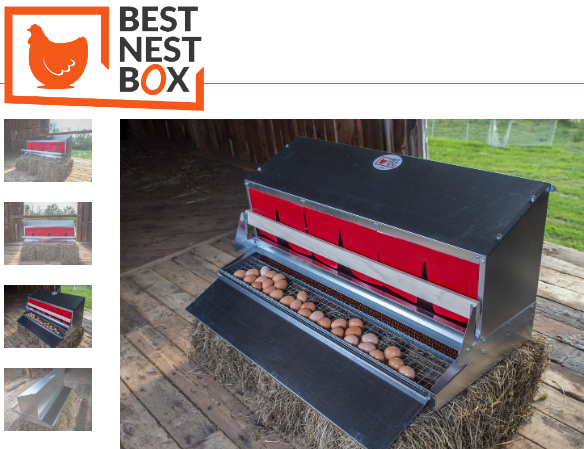
I really liked these boxes and there are many different DIY types/variations of the roll away nesting box.  The basic principal is that the egg rolls to an area that’s hard or impossible for the chickens to peck.  I looked at various DIY types and liked the paint tray version the best.  It’s easy to make, would fit into my existing boxes with minimal remodeling, and are easy to remove and spray out when they get dirty.

Making them wasn’t too hard.  I bought the largest paint try that would fit into my existing boxes.  Besides fitting, the 10.75×15.5 tray seems to be a good size in general.  I bought a strip of outdoor grass carpet, created a pattern with the first piece of carpet, and used it as my template for cutting the rest.  It may be overkill, but I used outdoor carpet glue to adhere the carpet to the tray.  I wanted something that would withstand a strong spray of water for cleaning.
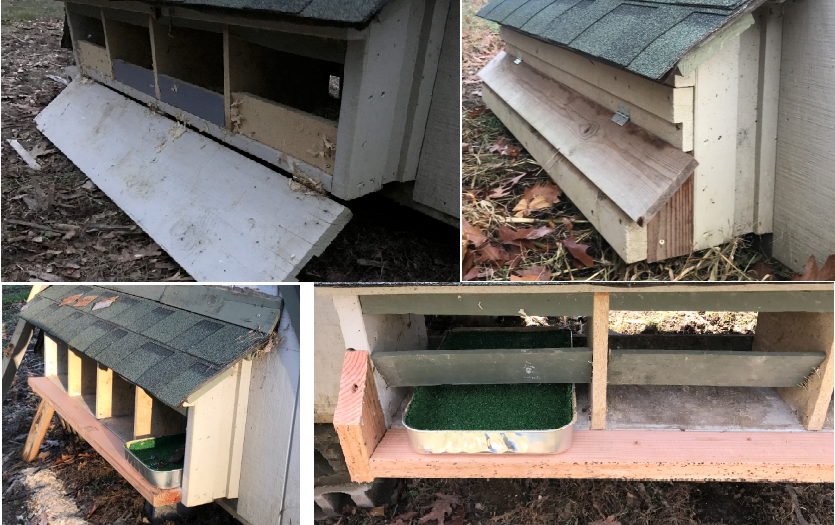
 

Top left and clockwise: Old box with drop down lid, Finished box with lift lid, Added 2×4 and blocker boards with paint tray example, Side view added 2×4 with tray example.

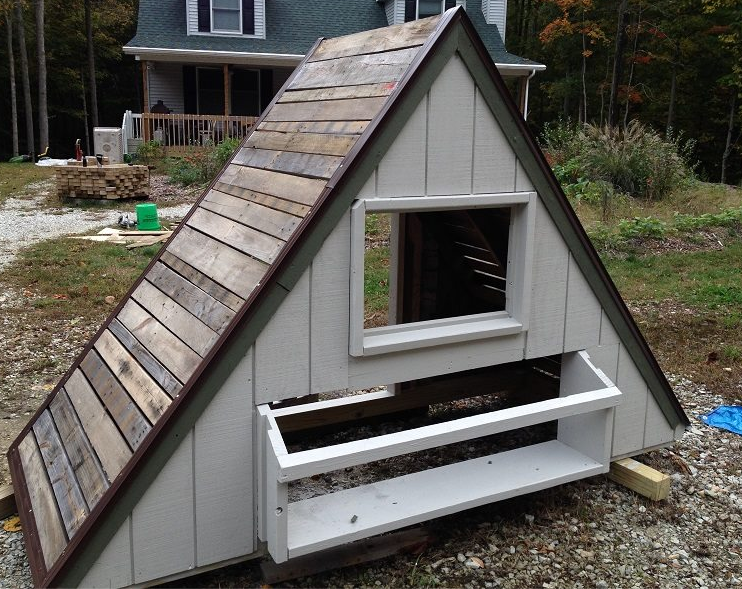
The refit of the boxes on the A-frame worked out good.  The previous door to collect eggs worked fine, but I would have preferred to have a lid that lifted instead of a door that flops down.

The existing boxes were too short to fit the tray, but it was easy to add length to the outside which also created the protected area for the eggs.  A 2×4 length worked great and I cut the old door and used to fill in the new wall sections of the new enclosure.

I added the green blocker boards inside the boxes where at the start/end of the deep part of the try.  This is to prevent the chickens from being able to reach the eggs that roll down and collect in the bottom of the tray.

The refit also gave me the lifting lid I wanted.  In the pictures, I used a 1×6 I had laying around for the lid, but I intend on using a 1×8 to cover it better and give me an area to lock it down.


We’ve used these boxes for over 8 months and it’s great to see eggs under the lid.   They are peck free and much cleaner.  Our current layers are fickle and tend to lay in the corner of the coop instead of the boxes; however, we do get frequent eggs in the boxes too.  Our new ISA Brown flock is laying consistently in their temporary boxes.  I look forward to them using the roll away boxes.
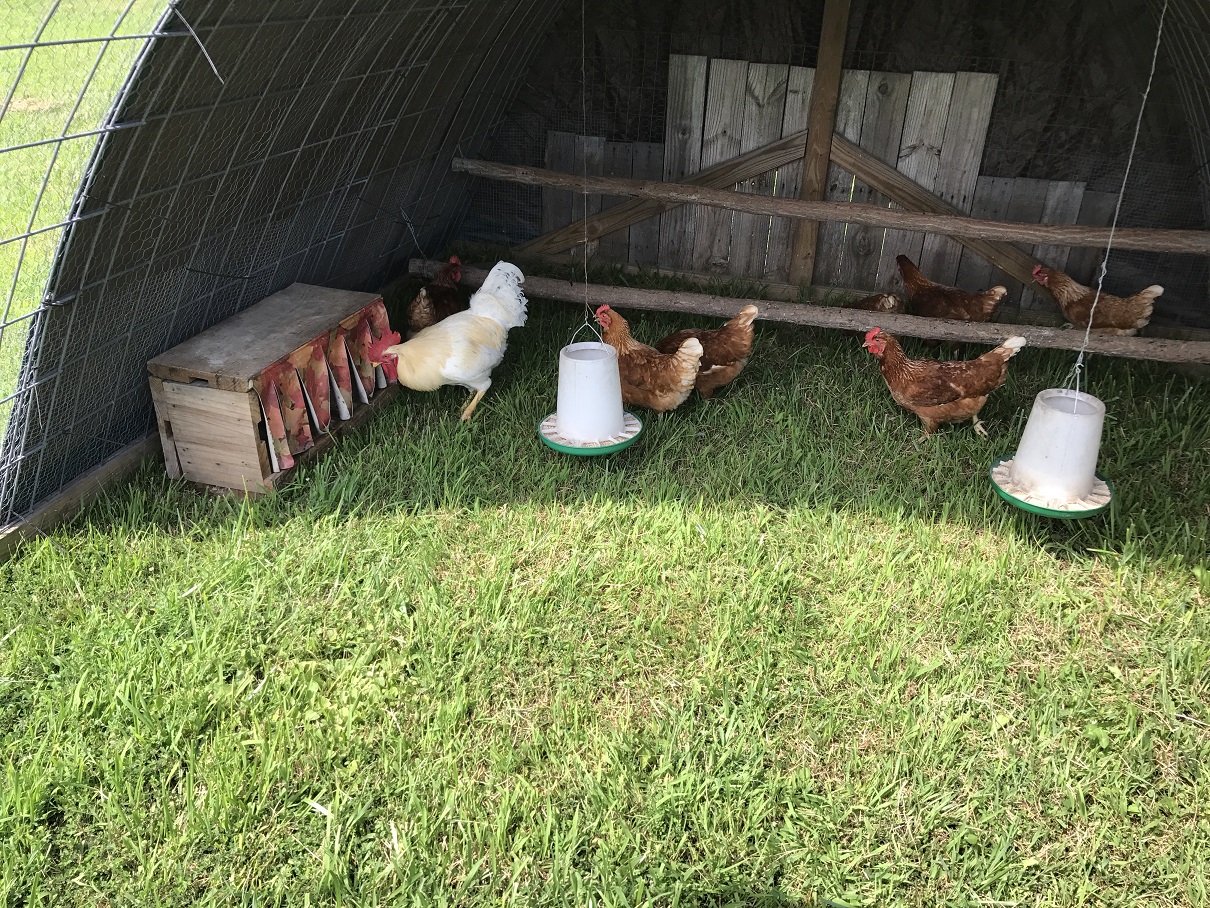
Chicken Tractor – for layers and broilers

As I’ve mentioned in my Chicken Tractor Guide, you can use the chicken tractor design for layers.  So this summer and fall we’ve used our idle chicken tractors to house the new flock of layers while the old layers are in the A-frame coop and being phasing out.

Layer Boxes

Since this was temporary, I did not fasten the layer box to the back wall, but you could easily make a light weight set of 2-3 boxes to hang off the back wall.  Instead we used a double box I made out of scrap 2x wood for another project.  It’s heavy but works good.


Tractoring

Optimal moving depends on the stocking density.  For our 8 birds I’d say about every 3-5 days.  We’ve gone as longer during busy spells, leaving the ground looking like a post-apocalyptic movie scene.  I reconciled staying in one place so long with the fact that using good feed and the pasture has plenty of time to recover before next year.

Their foraging area is much smaller than the A-frame; however, that can be mitigated with more frequent moving.  Also, I’ve already experienced that this lighter breed can fly over the chicken wire fence we use for the A-frame.

A final note. This ISA Brown flock really dug into the soil much more than my previous breeds leaving many deep holes when we removed the tractor.  I say deep, but the deepest was about 4-5 inches.  They seem to digging shallower holes as time passed, which may be a factor of us moving them more frequently or just age.


Supplemental roofing for the tractor


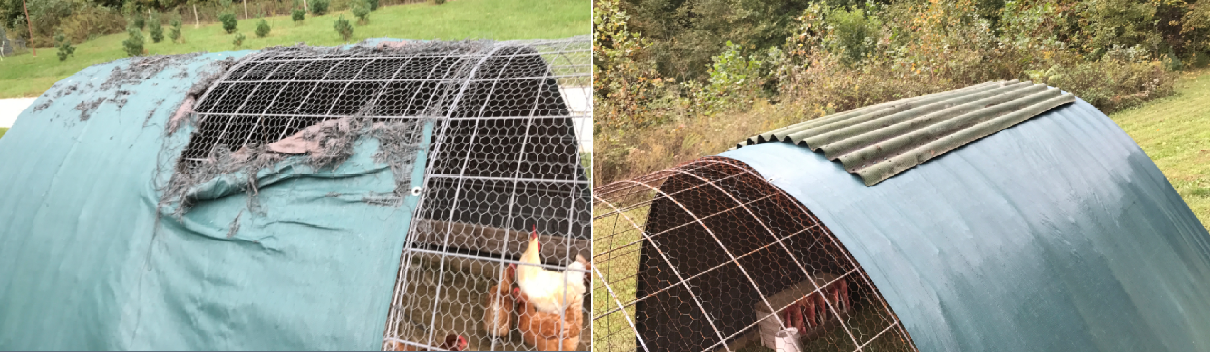
Since we have roosting poles already in our tractors, we only had one real issue, the tarps.  The tarps are medium duty and will typically last until the fall, sometimes longer, unless you have birds resting on them as we do.  Last year it was the crows that tore up the tarps.  This year it’s our flock of Guinea fowl.  Check out what a week of roosting can do to a tarp.


Fortunately I had an old piece of roofing laying around that I could attach to the top.  The boys just held some scrap pieces of wood on the inside of the coop that I fasten the roof to with screws.  This will protect the tarp and ensure a dry area underneath for the food dispensers.


Winter

October came and I decided not to move the chickens to the A-frame.  A chicken escaped the tractor during feeding and we caught her that night perched on the fence that keeps my Rainbow flock contained around the A-frame.  It’s really nice having them in the tractor, not needing to open and shut the coop each day and not worrying about them flying over the fence or aerial predation.

The cold of winter is my biggest concern.  I would want some better protection than the tarp and windbreak.  These are hearty birds and I’m think I could design a suitable shelter area in the tractor; however, snow is problematic for moving and requires some more thought.


The future of the layer flock

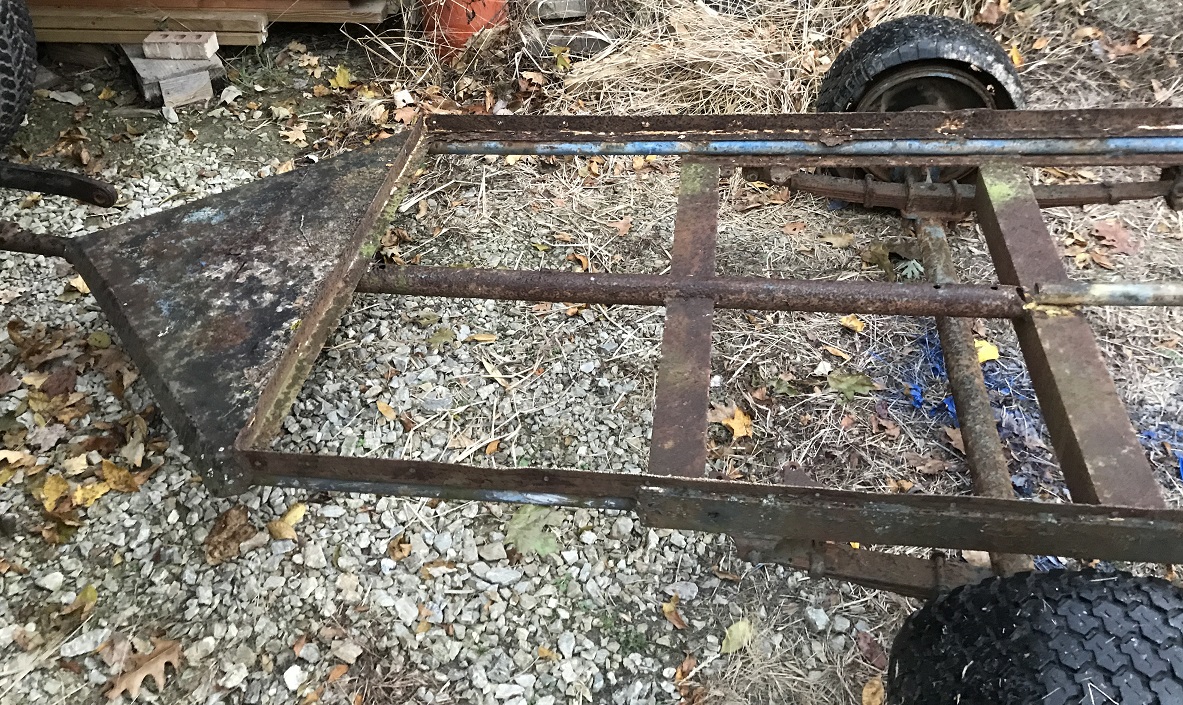
This experiment got me thinking about building a new chicken coup on a trailer frame and incorporating the best feathers of the A-frame, chicken tractor, and more.   Something very portable, versatile, and low maintenance.

Keep an eye out for the results of my new coop idea.  I’ll add a link to the new post here when it’s ready.  Until then, here’s a teaser.

Here’s the link.

-Jason

Guinea Pig Tractor

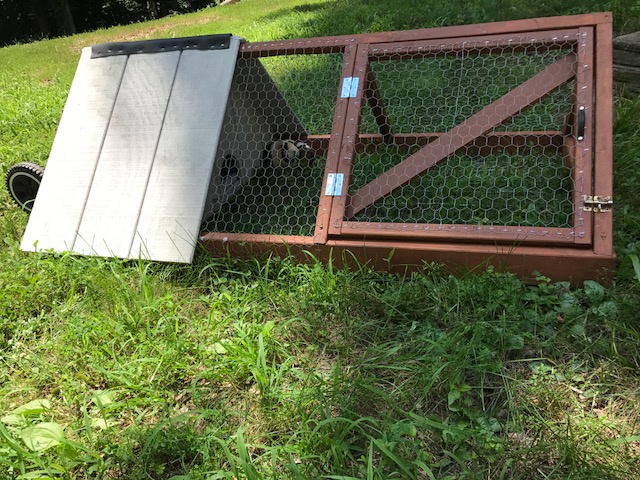
My wife asked me if the guinea pigs could use a spare chicken tractor during the summer so they could ‘free range’ and eat clover and such from the yard.  A chicken tractor won’t hold a guinea pig; however, I used a lot of what I’ve learned building the tractors and coops to make a ‘Guinea Pig Tractor’.


I’m not going into a “how to” on building a guinea tractor, like the “How To Build a Chicken Tractor” guide I did, but here are some basics.  I purchases 2 2x4s and 4 2x2s and scavenged the rest from leftovers of other projects.

I started with a 2×4 frame, cutting the boards at 34″ to give me the inside width and ~5 feet left over for the length boards.  I used a scrap 2×6 for the board on the end with the house so that I could attach some wheels later.  That gave me an extra 2×4 to use for the floor/nailer of the house area.

The tricky part was the 45 degree A frame.  I calculated the length needed as ~24″ for the “rafter” pieces, subtract the width of the 2×2 header, and that gave me ~23.5.  Measuring  from each end of a 2×2, then making a 45 degree cut angled toward the end, so 23.5″ is the length from the tip of the angle, will let you get 4 rafters out of one board.  Measure 23.5″ from the remaining tips and made 90 degree cuts at the marks.  See layout below below.  I cut 8 rafters out of two of the 2x2s.

I cut the 3rd 2×2 at 34″ and attached it to the back 2×6 and attached the 2×4 flat to form a ledge for the house floor.  The width of the hose is 14″ because of the scraps I had to work with.  The leftover 5′ from the 3rd 2×2 becomes the top header.  I pre-drilled the screw holes in the header where I attached the diagonals, making sure to offset the screws so they didn’t hit when they crossed.  I attached the diagonals at each end, under the inside of the house, and where needed for the door in the tractor.


I used the 4th 2×2 to make a 2′ door to the tractor area.  The rest was just fitting my scraps in the house shape and stapling on the chicken wire.  I also used 2×4 fencing on the bottom to keep any predators from sliding under the sides and into the tractor.


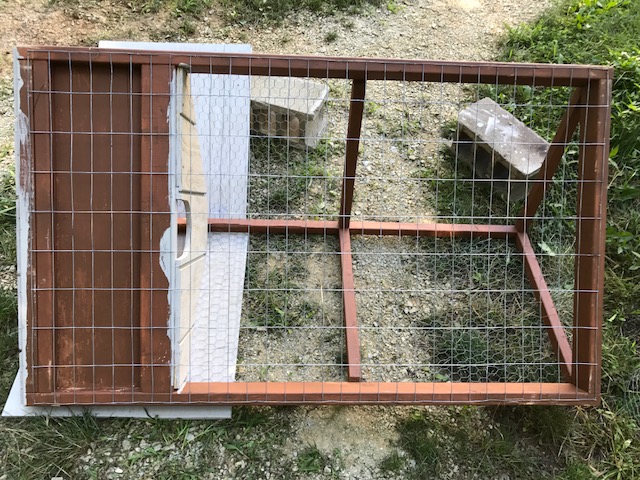
In these pictures I have a board as the floor of the house area.  I later removed this because guinea pigs are not particular about defecating in the area they sleep in and this area was difficult to clean.  It’s now just fenced in open bottom like the run area.  To clean it, we just move the tractor.


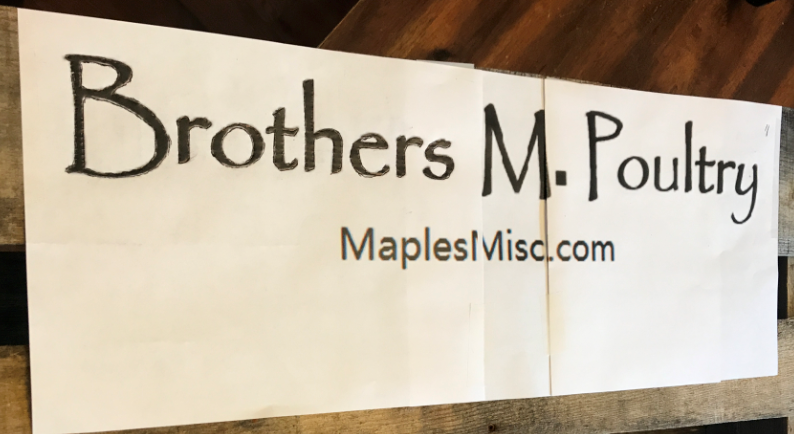
Brothers M. Mondays – New Sign painted by our artist

Brothers M. Mondays – A new post each Monday until the 2018 market season starts on 5/26.

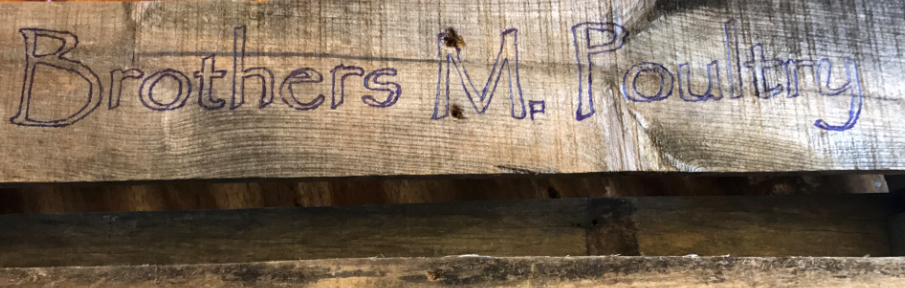
We needed new signs for the farmers markets.  Samantha offered her talents to help with the creation.  She likes painting and does a good job, so filling in the tracing lines was a snap for her.

The signs are made of recycled pallet wood.  They feature a rope handle and space in the middle to carry most of our farmers market materials.

We used a home made carbon paper method to transfer the outline to the boards for painting.  Basically cover the back side with pencil graphite then traced real hard.


Don’t forget our CSA is still open, check it out.

Chicken Tractor Plans – Part 3

Last year I had to add detail to my parts list, which lead me to create the below outline and part list.  If you’re familiar with carpentry,  you should be able to take this blog and build a very sturdy and versatile chicken tractor.   Add this post to the basic diagrams in my earlier two posts, part 1 and part 2, and enjoy.

That’s not all.  This outline inspired me to write a 75+ page step by step how-to guide with illustrations, additional information, and personal experiences.  If you would like this detailed how-to guide, CLICK HERE.

As always, thank you for checking us out and all your support by liking and  sharing.


Supply List with  details.

Main Items

      • 3 – 16’x50” cattle/feedlot panels
        • Form the “hoop” structure Slightly overlapped
        • May want to cut one rung off end to shorten it so tarp can be stapled wood base easier.   Tarps come a little short because the measurements are raw not finished.
      • 5 – 2x4x12 treated
        • 2 – 12′ base sides
        • 2  – Cut 10′ base ends – 2′ extras become door diagonal supports
        • 1 – Cut 43″ for door frame top & cut 2 – 50″ sections  for back diagonals
      • 1 – 2x4x10
        • 1 – Cut 2 – 59″ door frame sides
      • 4 – 2x4x8 treated (3 if using 2×2 back upright)
        • 1 –  cut into 2′ lengths for corner braces for bottom frame
        • 2 – Rip in half to use for door
          • Or use 4 2x2x8 furring strips, but should stain them if not treated
          • Gives 4 2x2x8
            • 1 –  cut into 55″ and 31.5″ for side and top of door
            • 1 –  cut into 55″ and 31.5″ for side and bottom of door
            • 1 –  cut into 31.5 for middle brace on door
            • 1 – (optional) cut 61″ for back upright instead of using a 2×4
        • 1 – Cut 61″ for back upright
      • 75’ – 4’ Chicken wire
        • 50′ for 3 passes over the cattle pannels
        • 20′ for the ends
      • 50’ – 2′  hardware cloth, ¼” mesh
        • Perimeter of entire house.  Critter protection.
      • 20’ – 3’ 2×4 wire fence
        • Put over ends of coop for K-9 protection
      • 2 ½ – 3′ x  5-7′ scrap for back end weather board to give extra shelter
        • Should be fairly light
          • Thin pallet wood, what I used.
          • Sheet of tin roof
          • 1/4-1/2″ plywood or OSB
      • 12×16′ medium duty tarp, or heavy duty if you prefer.  Note the extra gets wrapped around the ends
      • 2 – 3” hinges
      • 2 – bolt latches
      • 1 – handle
      • 1 – large bag of zip ties. Used to fasten all the chicken wire, hardware cloth, fence, and cattle panels together.  So you want plenty.

Misc. Hardware

      • 2 – 3” hinges
      • 2 – bolt latches
      • 1 – handle
      • 24 – 3-3.5″ Lag screws. To assemble base, including corner supports
      • ~26 – 3″ deck screws.  To assemble door & frame and back upright and diagonals
      • 1/2-3/4″ Staples for staple gun
      • ~32 – 1 3/4″ Galvanized Fence staples.  To attach the cattle panels to the base and anchor the door and back upright.
      • Fasteners to attach the back weather break that won’t penetrate the 2×4 it’s going into.
        • 1 1/4 – 1 1/2 16GA staples (pneumatic stapler)
        • 1 1/2 – 1 3/4″ screw (Better than hand nails)
        • 3d-4d nail (d=penny)
      • 12’x16′ medium or heavy duty tarp.

Optional Apron

      • Ends
        • 25’ – 2′  ¼” hardware cloth
          • Will actually use approximately 12′, 1′ overlap on the ends.
        • 2 – 1 1/4″ x 10′ PVC pipe
        • For front and rear aprons
      • Sides
        • 25’ – 2′  ¼” hardware cloth (Can us e leftover from front and back apron if only 12′ was used for ends)
          • Will use approximately 13-14′.  Thirteen feet will give a 6″ overlap of the front and back apron while using just 1- 25′ roll of hardware cloth.
        • 3 – 1 1/4″ x 10′ PVC pipe
        • 2 – 1 1/4 PVC coupling


How I build the chicken tractors. 

    1. Start with the 10×12′ frame.  The 10′ end pieces should be raised about an inch to help pull the tractor over clumps of grass.
    1. Add diagonal corner braces.
    1. Hoop 3 sections of cattle panels.  They will overlap slightly. Nail them to the base and wire tie hoop sections together
    1. Assemble the door.
    1. Cut the door frame and attach to base and hoop with screws and fence nails.
    1. Cut and assemble the door.  I wait to attach it after I’ve stapled the chicken wire to the door.
    1. Put in rear vertical attaching the top to the hoop with fence nails.  Attach the diagonal supports.
      1. Add your end material for additional shelter.  Note: This side of the tractor will go to the most windward side, west for me.  The upper section is just covered by the tarp and can be raised for additional air flow. (don’t attach tarp yet)
    1. Cover the hoop with chicken wire, 3 passes of 4′.  Overlap slightly. Staple to wood frame and zip tie together and to the hoop.  I use a pneumatic staple gun with 5/8 staples, but a hand stapler should work fine, especially if you use a hammer afterwards to ensure they are tight.
      1. Note: If you don’t have a continuous 75′, such as two rolls of  50′ and 25′, plan it out first.  Cover the hoop, then back.  Save the front (door end) for last as it uses  3 smaller pieces.
    1. Cover the back and front sections and door with chicken wire.
      1. Note: the bottom 2′ will be hardware cloth and the upper section will be chicken wire.
        1. If you purchased 75′ you should be able to piece together the entire door and sides if you prefer.  I do the front and rear end across bottom with hardware cloth,  then the piece in the tops with the chicken wire.
    1. Surround the perimeter with 2′ hardware cloth.  I added this to stop predators from reaching in through the chicken wire and grabbing birds sleeping near the edge.
      1. Cover the back bottom 2′ that isn’t protected by your end material with  Hardware cloth.  Optionally you can cover the entire back for extra protection depending on what back end material you used.
      1. Start from the back and move to the front.
      1. Note:  If you don’t have 50′ continuous role, plan you’re cuts accordingly. IE, for 2 25′ roles, start in the back and wrap up to the door using one role for each side.  Then do the door.
    1. Add 2×4 fencing to ends.  This is added for K-9/coyote protection.  Three foot  doesn’t make it impossible for a K-9 to get over it, but that height with the chicken wire too makes for pretty good protection.  So far we’ve survived 2 K-9 attacks.
      1. Note:  Use a type/size predators cannot force through.  I use 2×4 3′ 14 gauge welded wire.
    1. Attach door with hinges and add latches and handle.
    1. Cover 2/3 of the hoop with the tarp, wrap extra around back.  Staple the tarp to the wood base and wire tie the eyelets to the hoop.
      1. Note:  My medium duty tarps last one season.  I remove and re-add each season.
    1. BONUS: Add an apron to the front and back for added protection.  You can also do the sides.
      1. Staple 12-14′ of 2′ hardware cloth to the front and back base, leaving 1-2′ of overlap past the tractor.  I try to leave it a little loose so it has a little “hinge” to it.   I don’t know that it’s required.
      1. Wire tie a PVC  pipe to opposite end of the hardware cloth for weight.
        1. Note:  If you cut the PVC end of the hardware cloth and bend the points down, it’s more of a deterrent for critters that might burrow under.

-Jason


Copyright © 2018 by Jason Maples

Dual-purpose Chickens – 10 – Moving the coop update

In fall of 2014 I decided I wanted to raise some dual-purpose chickens.  My focus is on a breed that lays good eggs which can be incubated to raise “panfry” broilers, pre-Cornish-Cross size meat birds.  So how about an update on how I move the coop.


I tried to keep the size of the coop minimal so that it could be easily moved.  It’s still heavy and challenging to move.  My initial thought was to add permanent retractable wheels to one end and add some sort of a trailer type tongue to the other end for lifting an pulling.  Due to the weight, the tongue never happened.  Instead I still used the retractable wheels, but also put a sledge under the opposite “tongue” end and pulled it like a sled.


This wasn’t optimal.  The coop was too heavy for the retracting mechanism I made for the wheels.  It was also hard to lift the coop to put the sledge under the other end to drag it with.  Additionally, in the spring I had to use the tractor to move it because the garden tractor would get stuck, #1 The Coop.

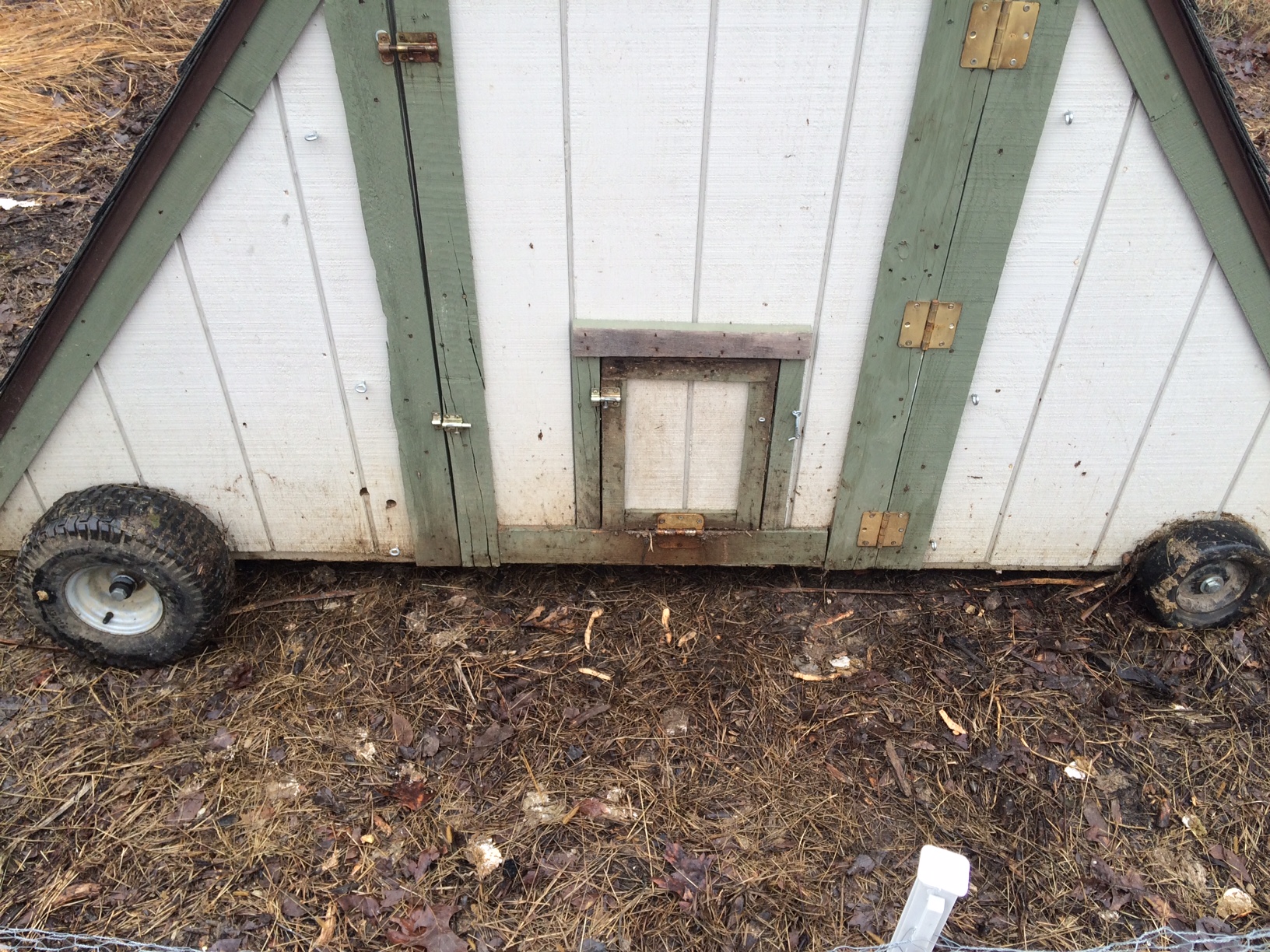
So  I scrapped the contraption I made for the extendable wheels and  decided to use temporarily attached wheels instead.  I scavenged two more wheels from  the front of a dead riding lawn mower.  For axils, I use 8″ bolts that are the same diameter as the original wheel axils.  I drilled holes through the coop’s 4×4 bottom frame and just slide the wheels and bolds right on.  I added some spacers between the wheel and wood to prevent rubbing.

This works well.  Our winter area can get mucky, as you can probably tell by the picture to the right; however, the wheels still allow us to pull/push the coop by hand.  A small scrap piece of  chain added to one end helps us to pull or allows us to use the garden tractor for longer distance hauls.


The main downside of this method is that it requires at least two people to tip the coop and put the wheels on.  You could use a lever or jack to raise each side, but since I have two boys, it takes just a few minutes to tip the coop each way and add the wheels.

-Jason

Dual-purpose Chickens – 9 – Suplemental Light

In fall of 2014 I decided I wanted to raise some dual-purpose chickens.  My focus is on a breed that lays good eggs which can be incubated to raise “panfry” broilers, pre-Cornish-Cross size meat birds.  So, how do I provide supplemental light for consistent laying?


The 3 breeds I’ve raised so far,  Buff Orpingtons, Delaware, and Rainbows, are sensitive to the amount of “daylight” they get in relation to egg laying.  In the seasons when the days are shorter, they stop laying.  I’ve heard some breeds are not as sensitive and will keep laying, but these breeds slowed down and almost stopped on me before I added light to extend their “day”.


120Since I do want year round laying, I have to supplement the daylight with artificial light.   When the coop is near an electrical outlet, it’s easy enough to use a standard multi-time timer to power a CFL bulb in the coop.  However, we normally only bring the coop near an outlet in the cold part of winter and the birds still need supplemental light in the fall and spring when no outlets are near the coop.


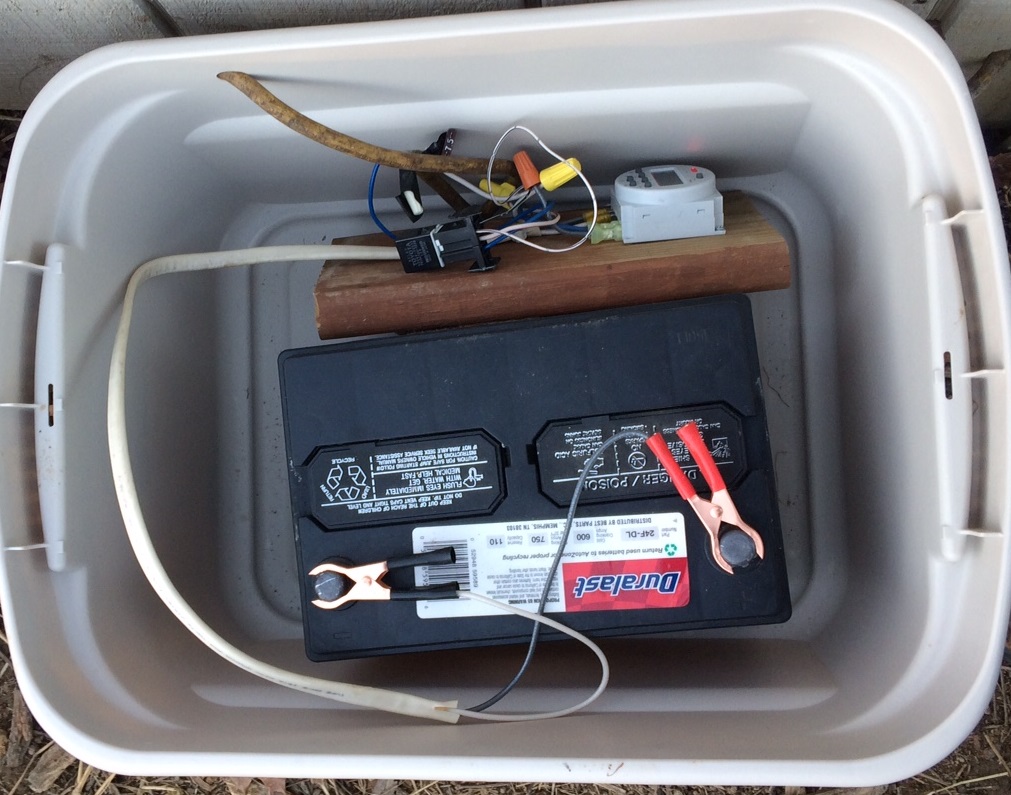
toteTo solve this, I built a DC light box.  For the light,  I ordered a 12VDC LED bulb that plugs into a standard receptacle.  I took the plug off a hanging lamp and stripped the wires to attach them to unit.  I purchased a $10 DC timer that has 16 programmable on/off times.  And I alternate deep cycle batteries for the power supply.


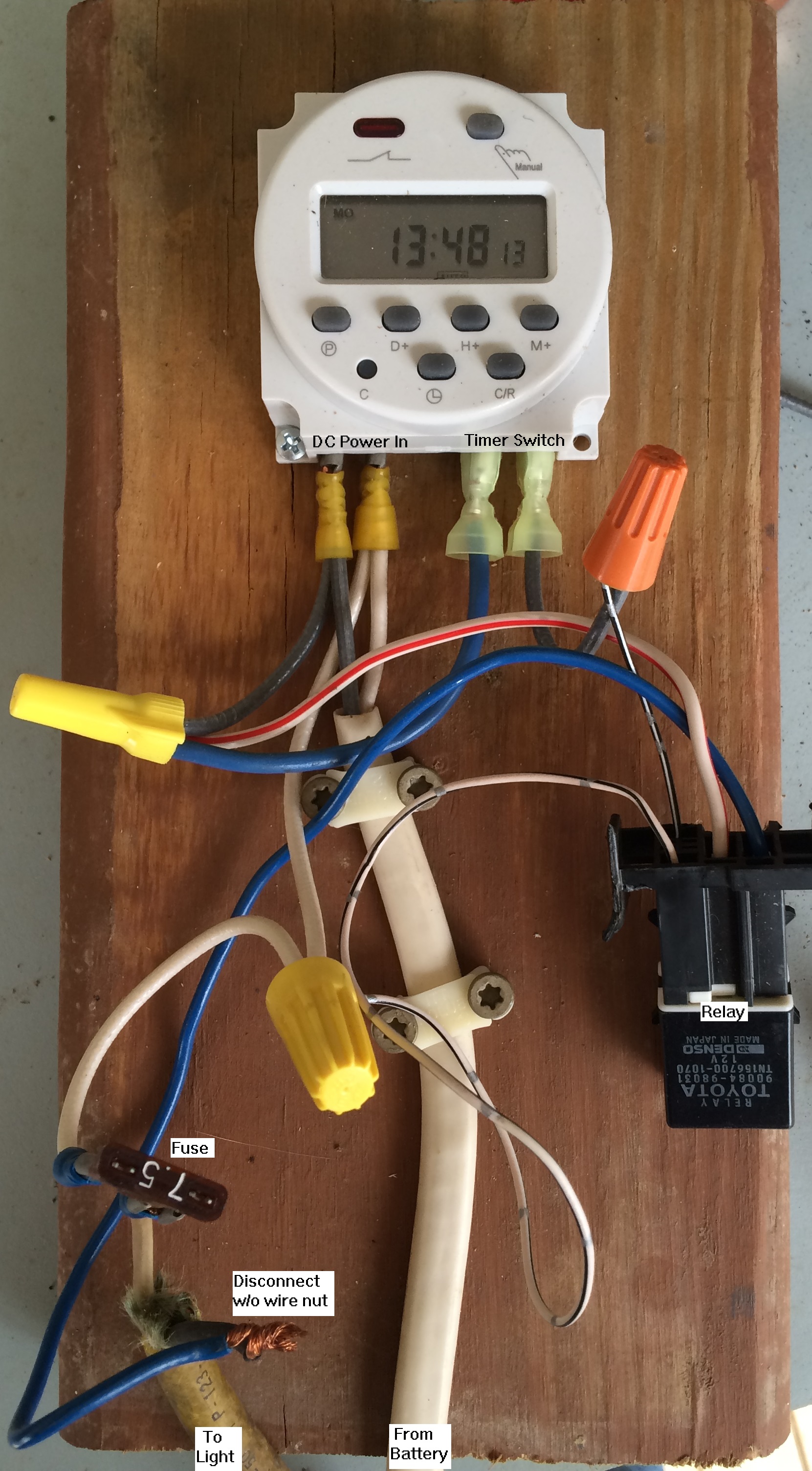
I followed the instructions to hook up the timer; however, the switch on the timer wouldn’t handle the amperage of the light if I ran it through the timer switch.  So instead, I ran a car relay off the timer switch and wired the light through the relay.  I added a fuse in as well, mainly because I already had the female spade connector cramped on and also wanted an easy disconnect in that spot anyway.  It may not be pretty, but it works.


lightTo run the light into the coop, I disconnect the lamp wire and feed it through a hole I drilled in the coop and another hole in plastic tote that houses all the electronics.

This setup works pretty good.  I have two light cycles programed, one in the morning and another one at night.   I can get at least 5 days off one battery charge running 4-6 hours of light a day.  Below are the descriptions and links to the bulbs and timer I used for your reference.

-Jason


(Pack of 2) 5w E26 LED Bulbs, 12 Volt, Warm White, Round Shape, 40w Equivalent, Solar Powered LED Bulbs, Off Grid LED Bulbs

FAVOLCANO CN101 DC 12V 16A Digital LCD Power Programmable Timer Time Switch Relay

Dual-purpose Chickens – 8 – Winter Water

In fall of 2014 I decided I wanted to raise some dual-purpose chickens.  My focus is on a breed that lays good eggs which can be incubated to raise “panfry” broilers, pre-Cornish-Cross size meat birds.  So, how do I keep the water from freezing?

One of banes of winter is frozen livestock water.  In the past, we’ve use 3 plastic 1 gallon waterers and rotated them throughout the day, bringing the frozen  ones in to thaw.  This was not an optimal solution.


I did some searching and was intrigued by an idea of using a tire to accumulate solar heat, and straw and a board inside the tire as insulation.  However, that would not work around here once the temperatures dropped well below freezing.


The idea I settled on was to use a concrete block with a light bulb inside, especially since the coop was going to be close to a power source.  It was easy to make.  Just an extension cord, a plugin light receptacle, a cooking tin, and a concrete block.  Put the cord, receptacle , and light bulb together and slid them into the concrete block.

base    light

To keep the block sitting level, either chisel a grove in the concrete block or sit the block on two pieces of wood and run the cord in-between the two pieced of wood.

Grove

And cover with a tin pan, to keep moisture away from the light.  Although I have metal waterers, I’m using the plastic ones as I think they handle the water freezing better.

waterer

I’m using a 60W bulb an it has worked pretty good.   So far this year,  most days stayed above 20 degrees , but  a few days were close to zero.  These days produced some frozen “rings” higher up in the waterer;  however, the tray stayed unfrozen and the chickens had unfrozen water to drink.    One thing to watch out for is that when the water gets close to being out, the waterer is lighter and easy to knocked off.

-Jason

Dual-purpose Chickens – 1 – The coop

In fall of 2014 I decided I wanted to raise some dual-purpose chickens.  The main focus was on incubating my own birds to raise as “panfrys”, traditional meat birds frequently used in pan frying.  So I needed a coop.

Using some pallets and leftover materials from my shed, I was able to build a nice A Frame coop for about $150.  It has 4 nesting boxes in the rear with outside access and perching poles on either end.

a-frame1a-frame2


I wanted it to be fairly easy to move, but it’s really heavy.  I guess that’s is good so it doesn’t blow over since it’s narrow.  So far, the best way to move it is by dragging it across the ground after placing a “skid” under one side.  I attached some extending  wheels from the front of an old rider mower to one end, to the left of the bucket in the picture below.  That helps to move it, but it’s still a chore best done with my compact tractor or the garden tractor.

a-frame3

For Fencing, I started out using cattle panels with chicken wire attached and used zip ties to bind them together.  However, the panels were earmarked for my chicken tractor , were heavy to move, and expensive.  I only use a couple leftover 8′ sections now.  The rest of the fencing is step-in stakes and 36″ chicken wire attached to them at the bottom and on the top clip.  So far it’s been  enough to keep the birds in place.  They get locked up at night, so I don’t need the fence to keep predators out.  It’s fairly easy to move by un-clipping each stake and rolling up the chicken wire.


-Jason

Chicken Tractor Plans – Part 2

Just to add a little narrative on how I build the chicken tractors.

  1. Start with the 10×12′ frame.  The 10′ end pieces should raised slightly to help pull the tractor over clumps of grass.
  1. Add diagonal corner braces.  Not sure that size matters.
  1. Hoop 2 sections of cattle panels.  They will overlap slightly.
  1. Assemble the door.
  1. Cut the door frame and attach to base and hoop
  2. Put in rear vertical and diagonal supports.  Add something on the end bottom for additional shelter.  This will go to the most windward side, west for me.  Top is just covered by the tarp and can be raised for additional air flow.
  3. Cover the hoop with chicken wire, 3 passes of 4′.  Overlap slightly.
  1. Cover the ends & door with chicken wire.
  1. Surround the perimeter with 2′ hardware cloth (optional).  I do this to prevent predators from reaching in through the chicken wire and grabbing birds sleeping near the edge.
  1. Add 2×4 fencing to ends.  This is added to ensure K-9 type/size predators cannot force through chicken wire.
  2. Attach door and latches
  1. Cover 2/3 with tarp, wrap extra around back.


Copyright © 2018 by Jason Maples