Portable Chicken Coop / Tractor – Nesting Boxes

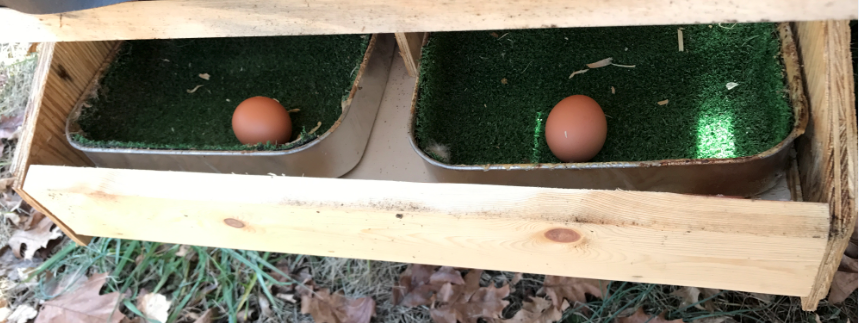
I cover my initial build of the boxes, including covering the paint trays, for the A-frame here.  As I mention, I really like this type of box.  And to follow-up from my first post, yes the new ISA Brown flock is consistently laying only in the boxes as I had hoped and expected.

The boxes for this coop are completely on the outside of the coop.  This gives me more room on the inside of the coop for roosting and waste/droppings management.  I put the boxes level with the floor.  I’m getting bedding shavings in the trays, which can prevent eggs from rolling down.  I’m not sure if higher tray would fix the issue, but I’m planning to move to a mesh floor without any shaving anyway, so the issue should resolve itself with the new floor.

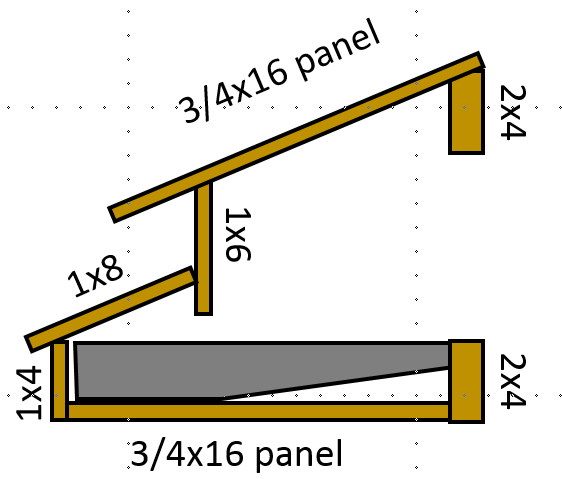
The dimension of the boxes are mainly to accommodate the paint trays, but I think are good for any box.  I typically do not oversize my boxes, especially in height.  I’ve read that keeping the boxes smaller and shorter discourages “parties” in the boxes that lead to droppings in the box.  So far that’s not been an issue in any of my boxes.  Additionally I use an old table cloth to make a divider to give the hens more privacy, which they really seem to like.

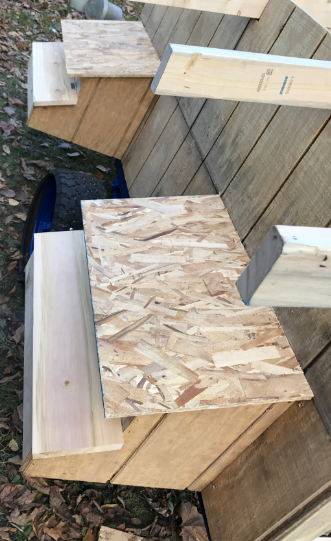
I started by marking the ends according to the blueprints, putting each board on the marks to ensure I had the right dimensions, then cutting out the end shape.  I then cut all the horizontal boards to the proper length.  I used standard 1″ & 2″ sizes and laid out the paint tray on the boards to ensure proper dimensions before I cut them.  The larger floor and roof I used scrap OSB and a an old shelf board I had on hand.


I took the roof angles from the ends used them to ripped an angle on the 3 boards that meet the roofs.  I could have just left them square and lowered them to the level of the roof, but I like the way the angle looks.

Then I sat the ends upright and started fastening the horizontal boards to the ends.  I have a staple gun which makes building boxes like this much easier.  It could probably be done without it, but I’ve come to rely on how well the staples work in edges of narrower pieces of wood.

I slid the paint trays in to view the heights.  The 1×6 that I used for the back of the nesting box did not go down as far as I liked.  It gave the chickens too much room to access the bottom of the pan.  I ripped a spare board in half and used it to add to both boxes.

I cut and stapled the center in place.  I have a staple gun which makes building boxes like this much easier.  It could probably be done without it, but I’ve come to rely on how well the staples work in edges of narrower pieces of wood. I also ripped the appropriate angle on the board that covers the egg area so it sits flush on the hinge side, but did not attach it yet.

Next I fastened the boxes to the frame using carriage bolts in the top to hold the weight then wood screws at the bottom to hold the box against the frame.  The frame had a lip that was perfect to rest the box on and use a clam to hold it in place while I fastened it.


Finally, I attached the roof sections.  The top one I just stapled down, the bottom one is hinged so t raises for gathering eggs.  Since I used OSB, the top roof has tar paper for now and will get a either shingles or a metal roof.  The bottom roof/door is a 1×8 and will just get stained.

Back to Portable Chicken Coop Main Page

Portable Chicken Coop / Tractor – The Structure 2

Tires

Several years ago, I said this build has been on my mind for a while, I decided a coop on a trailer should be low to the ground.  Honestly don’t remember why I thought this at the time, but I shared the idea I had for making tires shorter with my father-in-law.  He wasn’t so much interested in the lower trailer, but was very interested in tires that won’t go flat.

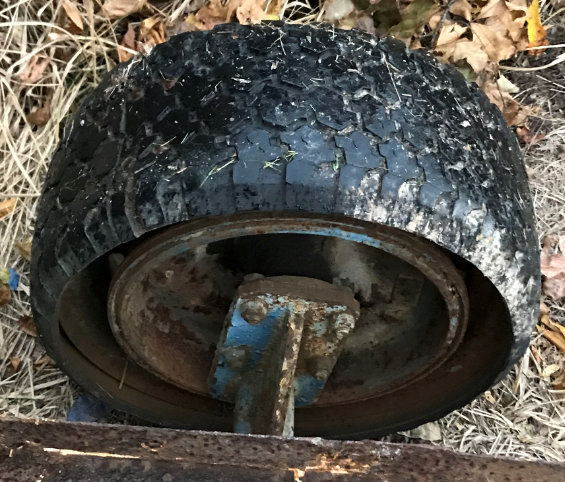
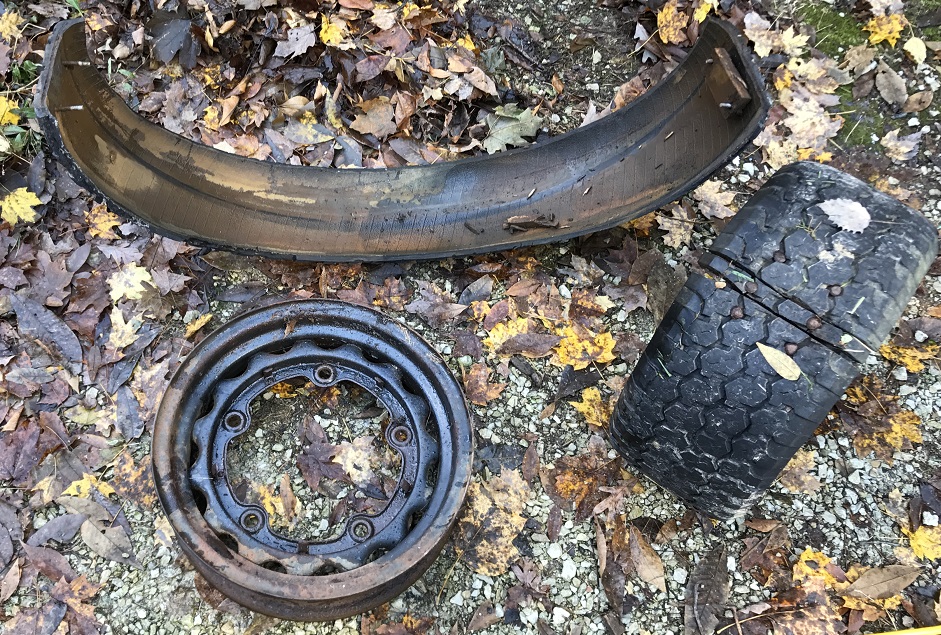
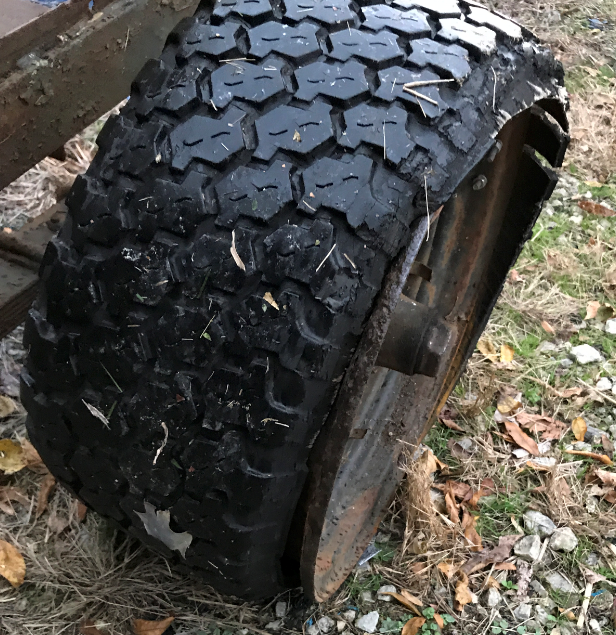
So the trailer’s tires he gifted me had been modified for about 2 years.  I give thanks again to my father-in-law not only for all the parts he donated to this project, but for making my job easier.  He already cut the sidewalls off the tires, shortened the remaining tread, and bolted the ends to the rim.  In addition to all this work, the passing of time and trailer use identified a couple areas that needed improvements.

Initially he only bolted the cut tires to the rim in one spot, where the rubber ends met.  A miscalculated in the circumference resulted in the tread being cut too short, hence the extra ad-on pieces you’ll see in the pictures.  The rubber was stretched tight and the edges curved around the rim, so it seemed like the rubber would not drift.  In this picture you see it did drift off the rim.  I added 2 additional fastening points approximately every 120 degrees.

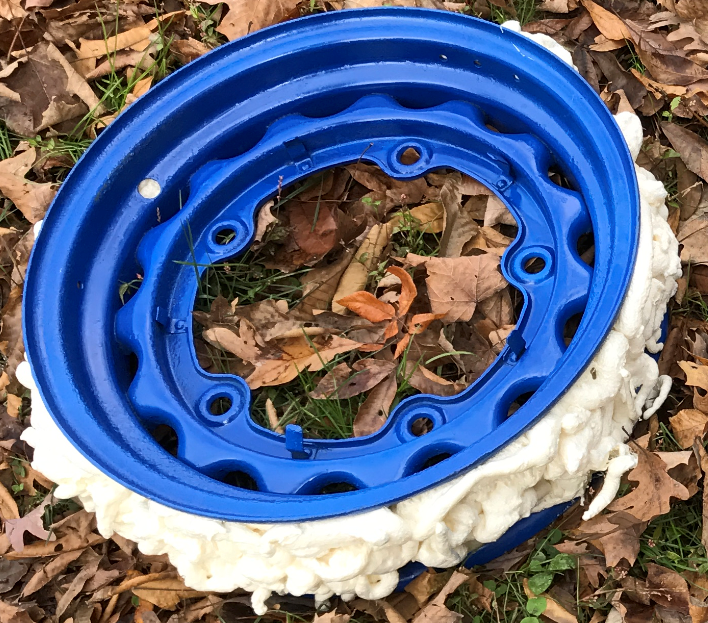
Second, where it was bolted wood pieces were used as spacers.  These rotted and fell apart.  I decided to used foaming insulation instead and becasue I was adding additional bolts, I did it completely around the wheel.


Lastly, the rotted wood pointed out that the cupped rubber on the wheel was holding water.  Standing water is not good for the metal rim to sit in.  This I haven’t mitigated yet, but the plan is to cut some holes in the rubber to allow for drainage, and have awnings over the tiers so they don’t get as much rain to begin with.  I overhung the roof in the back to do this, and in the front, I’ll add an awning that will double as an extension for water nipple.


Roof

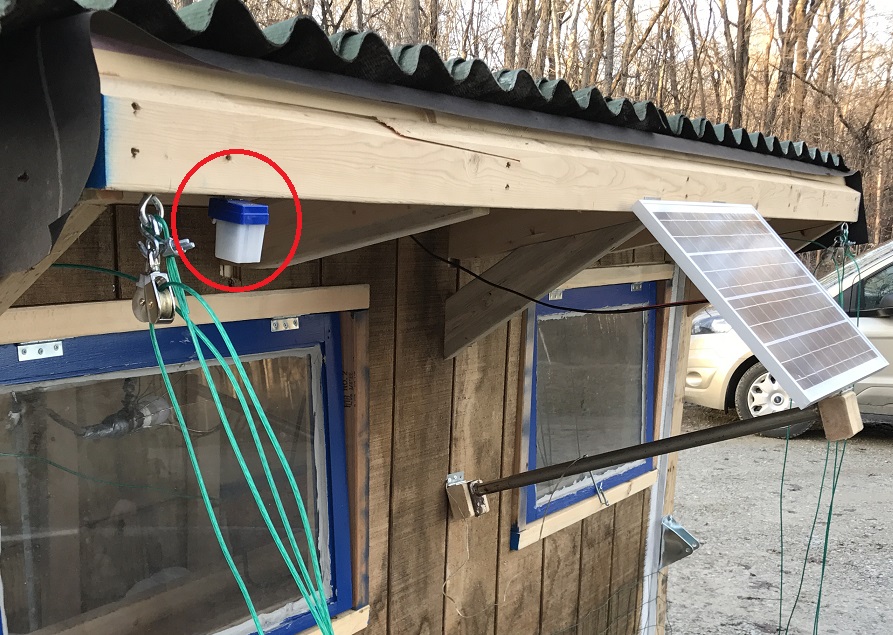
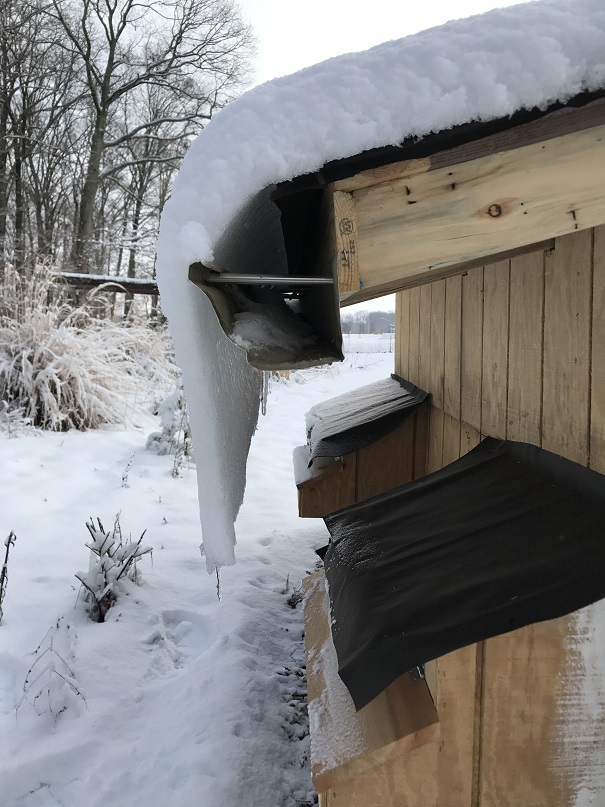
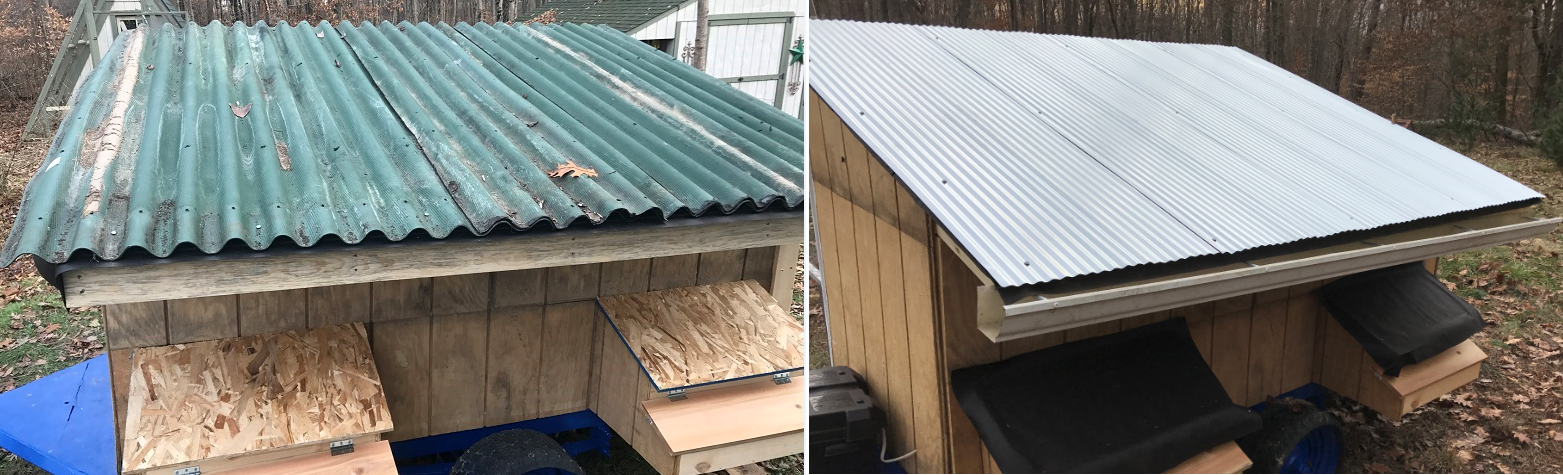
I wanted the roof to overhang in the front and back.  The backside covers the wheel and the nesting boxes.  I added a gutter for additional overhang to divert the rain away from the nesting boxes and for potential for rain catchment later.  As you can see in the picture, the additional length comes in handy in the winter.

The front overhang is to shade the windows in the summer, when the sun is high overhead.  During the cooler/cold seasons when the sun is lower in the sky, it will still shine into the coop for additional passive solar heat.  The overhang also helps with the pulleys for the aviary and to keep the rain off the windows and wheel.

I added a layer of foam board under the roof for insulation.  I’m not concerned with sealing  the coop tight, but I wanted more than a thin roof between the hot sun in the summer and cold in the winter.

Due to timing and budget, I started out with some used scrap roofing I picked up fee for projects.  What I had left was in pretty bad shape and I only intended it to make it through the winter before I replace it with a metal roof.  It didn’t.

Fortunately the high winds that blew off the first roof were from a warm front.  This at least providing me with a some above freezing temperatures as I replaced it with a metal roof.   I was going to special order a blue metal roof to coordinate with the blue frame, but when you need it today, you take what’s in stock at the hardware store.


Color

The final basic item for the build is the color.  Everything I’ve built since we move out here has been grey with green roof and trim.  This matches the house.  But as I mentioned, the trailer frame was previously blue and nearly screamed at me to be blue again.  Additionally, I didn’t have any grey stain on hand and had already spent more than my budget for the first phase of this project.

As I was fretting over the color change, I happened to watch this double-decker bus conversion video and at 12:10 the interviewer says “It’s green!”  and the builder’s reply was “It was going to be blue, but now it’s green”, basically because he’s made due.  I have white stain and white and blue go great together, so it was going to be grey, but now it’ll be white.

Additionally a white coop makes me think of it as a symbol of Captain Ahab’s white whale. In the last several years, chickens have certainly been my “white whale”.  I’ve also nicknamed the coop the Pequod.  Not sure it’s going to stick, but I tried.

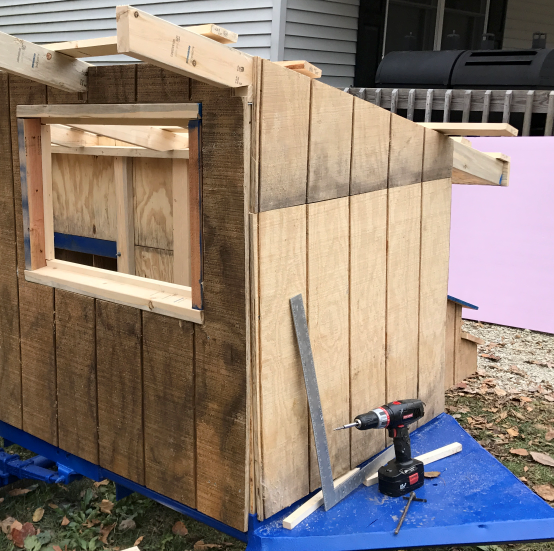
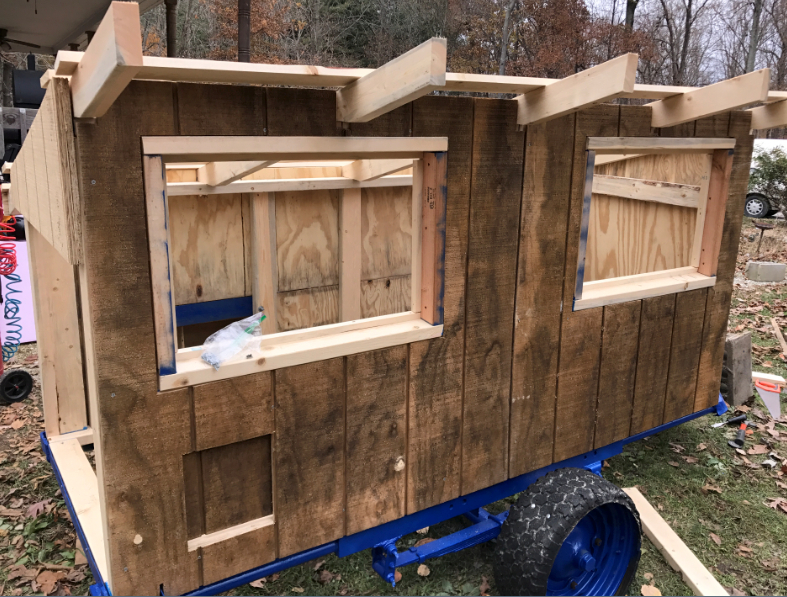
Finally, It goes against my upbringing to build without properly protecting the wood with stain, but I was limited by time and warm weather.  I settled for staining the trim and pieces that were going to overlap, so I wouldn’t have to take them apart later.   Hence why I went with white and why you see some white stripes on the ends.


Back to Portable Chicken Coop Main Page

Portable Chicken Coop / Tractor – The Structure

Trailer Frame and coop

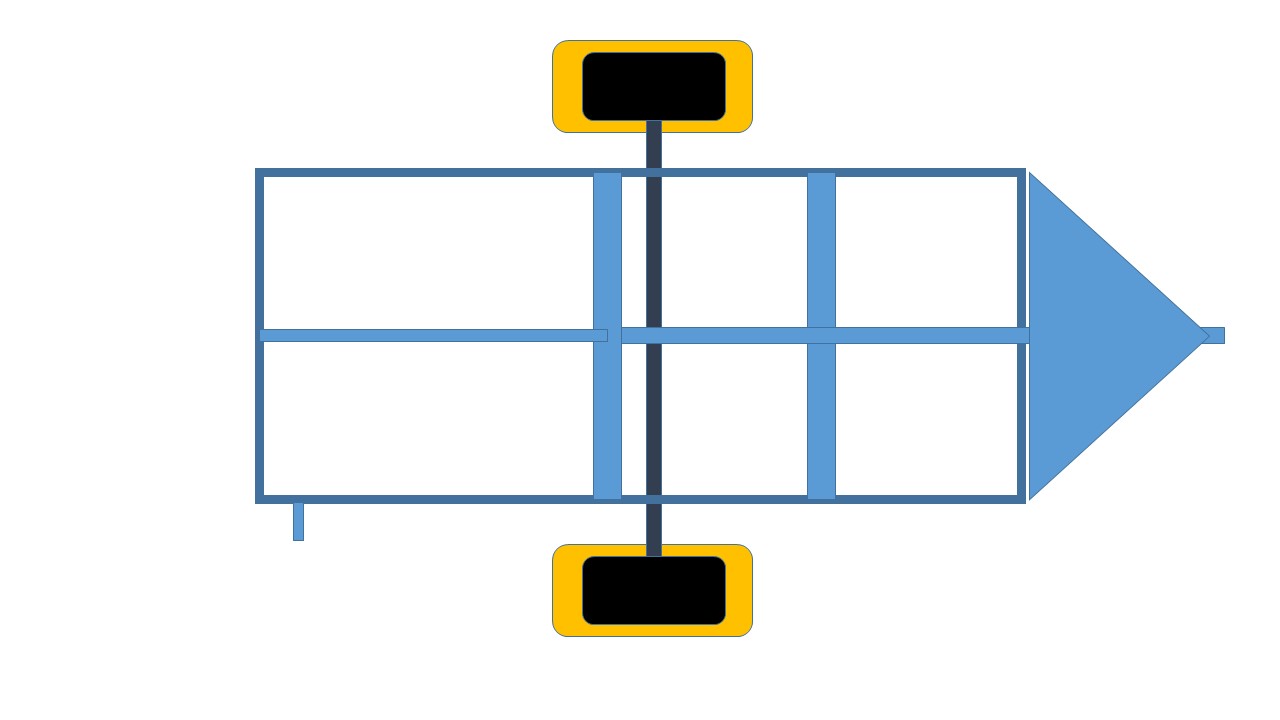
To me, easy to move means on a well-balanced trailer.  Chicken tractors are great, but I wanted more substantial winter protection than a tarp, which means more weight and harder to move.  I was gifted this frame(1) for this project.  It was pretty ruff, so I used a wire wheel to clean it up.  While knocking off the rust, I could tell it was once blue, so Rustolem deep blue it was.

I wanted to keep the center of gravity low, so a tall coop was out.  Additionally, I had several 4′ wide pieces of wood panels that were around 30-36″ tall.  Keeping the maximum height of the coop to 4′ in the front allowed me to use these scrap pieces and only purchase one 8′ panel for the front two sections, the trailer is 8’x3.5′.


Accessibility

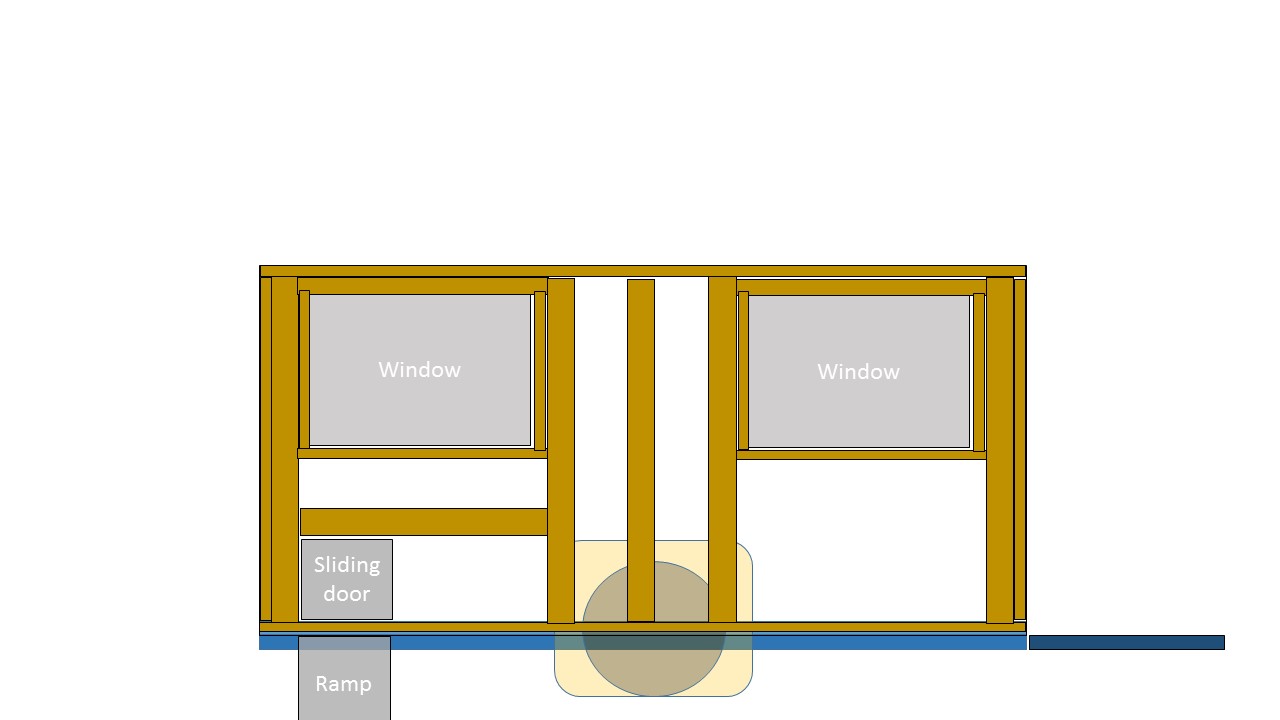
The low height meant two things.  Plenty of access from outside so I don’t have to go in and a remove able floor so if I do, I gain another 18 inches by standing on the ground.  Initially I planned on removable external nesting boxes and each end as a door; however, it was easier and less time consuming to semi-permanently attach the nesting boxes.  I’ve held off on adding a door on the tongue end of the trailer.  It’s bent upward, presenting complications with a full door and is also the best place to put the battery.  I’ll look at adding a smaller door later.


Lacking removable boxes and the 2nd door, I decided to make the windows access points instead; this will work out well when I need to remove birds while sleeping on the perch.  The windows were always going to be hinged at the top so they can be opened out and not let rain inside, so that access was covered.  However, instead of a fixed hardware cloth screen for the windows, I’ll make hinged screens that open giving access to the birds inside.


Floor

It has to be easy to clean and for that  I’m a big fan of open bottoms and poop boards.  Both are relatively easy to clean.  A mesh floor to let the droppings fall through is the ultimate goal, but after seeing the shape the trailer was in, I don’t want to encourage more rust by letting droppings fall on my new paint job.  I plan to mitigate this by covering the undercarriage cross members with corrugated pipe for protection and possibly easier clean-up.  Then I’ll build a frame and cover it with 1/2 inch mesh for an ‘open bottom’ floor.

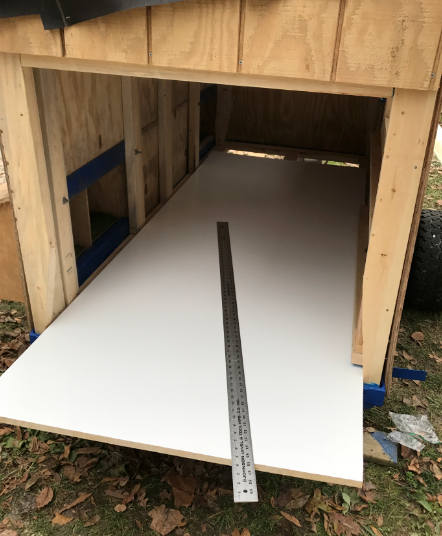
However, to save time this fall, I went with a cheap solid floor.  I picked this piece up for $5 in the damaged section, since it was damaged on the sides and I didn’t need the entire 4′ length.  It’s slick surface allows me to easily scrape it clean with a rake.  To get a better clean, or to get inside the coop, it’s removable.  The mesh floor will be removable too when I build it.


(1) Footnote: My father-in-law deserves big thanks and recognition for donating parts to this build.  He donated the trailer and windows in this post.

Back to Portable Chicken Coop Main Page

Portable Chicken Coop / Tractor – The Plan

Floor Plan

I’m not going to outline a step by step plan as I did in my free Chicken Tractor How-to Guide.  This is not a repeatable blueprint.  However, I did put a lot of forethought into this build.  Usually my plans stay in my head augmented by some hand drawings and/or notes.  But Bill Mollison teaches putting the majority of your time in observation and planning.  So this time I  created a better blueprint than I normally do, click on the images to make them bigger.

Why this coop?

Trailer Frame

We kept part of our layers in a chicken tractor this past summer and fall and I really liked it.  There was no fence to move, no coop door to open and close, and the open air tractor is great for pasturing.

So why not use a chicken tractor permanently?  The idea is very tempting and I may still convert a chicken tractor; however, there were several reasons or excuses not to.    Adding the refinements I wanted would mean adding weight and making it harder to move.  One person can move the chicken tractor, but it’s so easy with two we’ve gotten in the habit of double teaming the chicken moves.  Frankly I’ve gotten spoiled.  A coop on wheels allows me to put in a lot of features without worrying about the weight.

The girls would like to be able to care for the chickens without having to enter the tractor, because grown roosters are mean and scary.

Side View with boxes

We’d need whatever chicken tractor I converted in the spring for the broilers and I didn’t want to be under the gun to build a new tractor in the spring.

I really like the idea of easily moving the layers longer distances to any part of the property that needs worked, chickens and all.   The A-frame is fairly easy to move once it’s wheels are on, but it’s so heavy it takes a lot of effort to put the wheels on.  And worse, we have to catch and transport the chickens separately.

The plan.

Front View of Coop
Front View

I started by listing what I wanted and prioritizing.  Everything is designed to provide pasture and comfort to the chickens as well as simplicity for their human caretakers.  Below lists what I wanted, mostly in order of importance.  Being layers, we’ll have to interact with the flock every day, so things like multi-day feed and water were lower priority and things like easy to move and mobility were high on the list.

I plan on going into each of these deeper in future blogs.

Requirements

  • Easily moved by one person
    • Easy lift trailer hitch
    • Pull with something as small as a garden tractor
  • Enclosed aviary for scratching (tractoring)
    • Optional Skirt around coop for additional foraging/shade under coop/layer boxes
  • Peck-proof boxes with easy access lids on outside
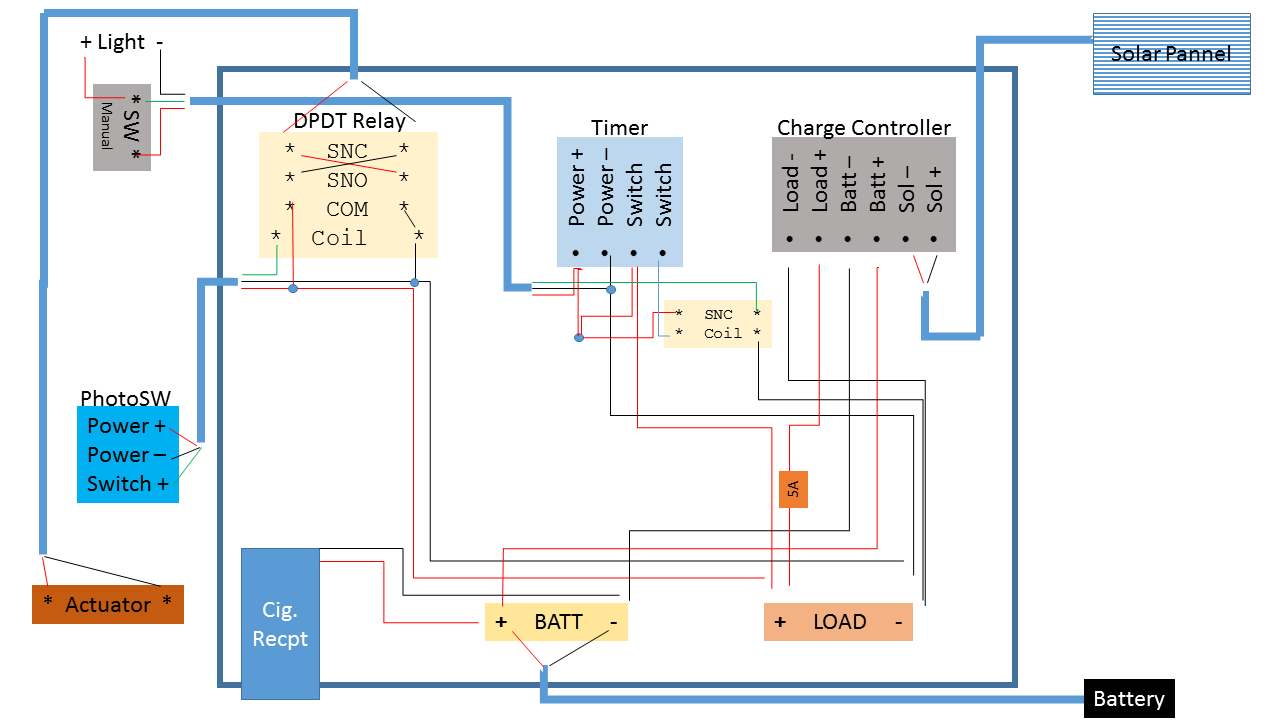
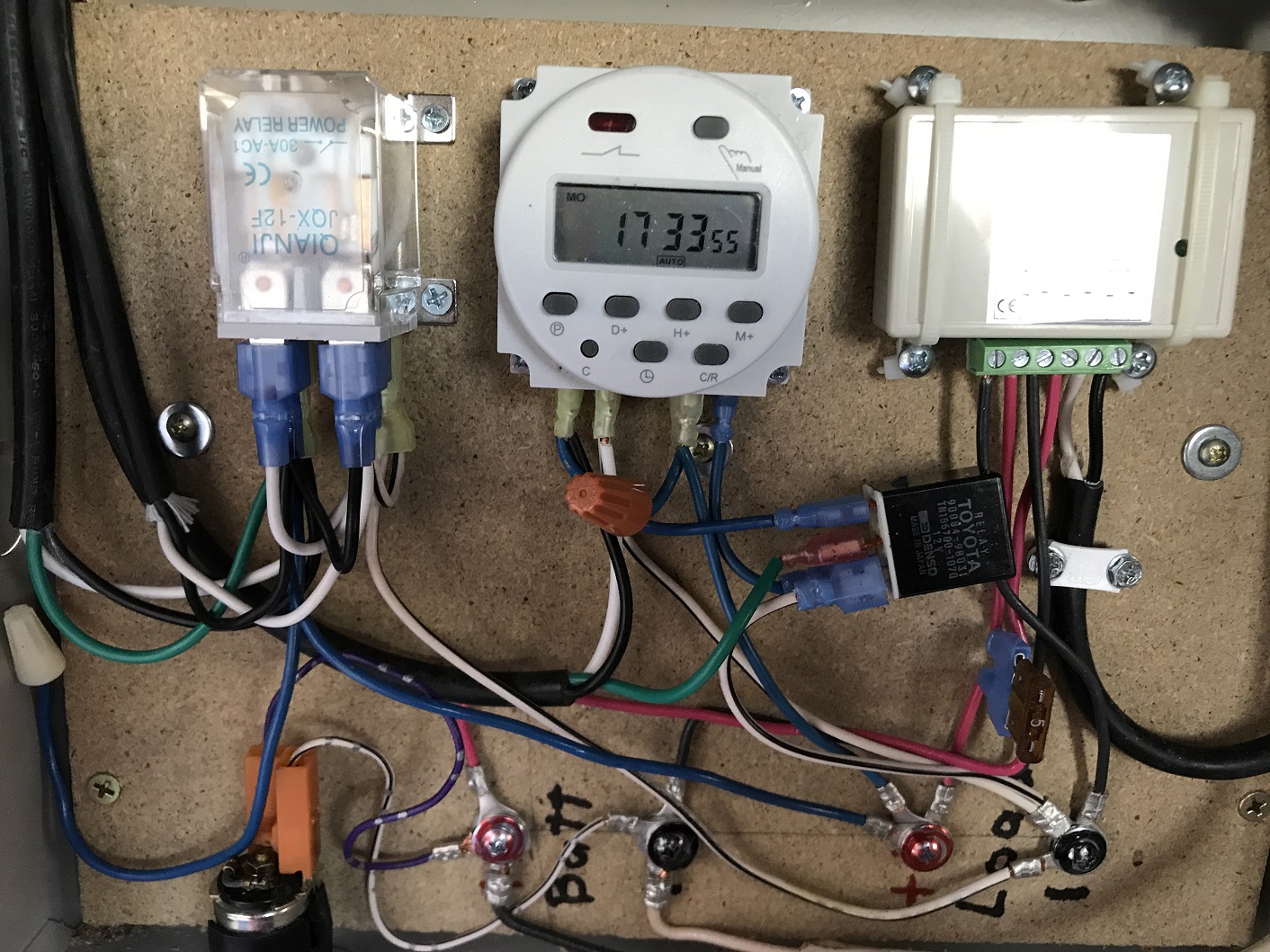
  • Automatic coop door.  This means power supply (batteries and solar panels)
  • Easy to clean droppings
    • Floor options
      • Open/screened bottom.  Allow droppings to fall through and open air
      • Solid board.   Removable and easy scrape surface
    • Continuous perching space, up to 20 birds
  • Windows and natural lights
  • Access panels all around so we don’t have to enter coop
    • Ends are doors
    • Removable coop boxes?
  • Anti-freeze waterer
  • Easy access food and water
  • Rain Catchment system

Back to Portable Chicken Coop Main Page

Dual-purpose Chickens 11 – Anti-pecking layer boxes

What to do when you have chicken(s) pecking eggs?  I’ve tried several things with minimal success including adding extra calcium to their diet, ceramic eggs in the box, and separating who I guessed the culprit(s) were. All of these had minimal success and required more resources.


Then I found these boxes. 

I really liked these boxes and there are many different DIY types/variations of the roll away nesting box.  The basic principal is that the egg rolls to an area that’s hard or impossible for the chickens to peck.  I looked at various DIY types and liked the paint tray version the best.  It’s easy to make, would fit into my existing boxes with minimal remodeling, and are easy to remove and spray out when they get dirty.

Making them wasn’t too hard.  I bought the largest paint try that would fit into my existing boxes.  Besides fitting, the 10.75×15.5 tray seems to be a good size in general.  I bought a strip of outdoor grass carpet, created a pattern with the first piece of carpet, and used it as my template for cutting the rest.  It may be overkill, but I used outdoor carpet glue to adhere the carpet to the tray.  I wanted something that would withstand a strong spray of water for cleaning.


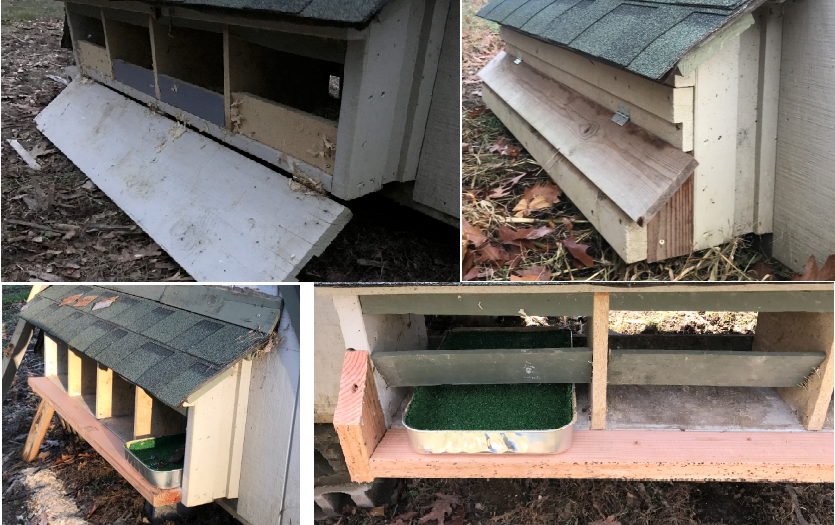
Top left and clockwise: Old box with drop down lid, Finished box with lift lid, Added 2×4 and blocker boards with paint tray example, Side view added 2×4 with tray example.

The refit of the boxes on the A-frame worked out good.  The previous door to collect eggs worked fine, but I would have preferred to have a lid that lifted instead of a door that flops down.

The existing boxes were too short to fit the tray, but it was easy to add length to the outside which also created the protected area for the eggs.  A 2×4 length worked great and I cut the old door and used to fill in the new wall sections of the new enclosure.

I added the green blocker boards inside the boxes where at the start/end of the deep part of the try.  This is to prevent the chickens from being able to reach the eggs that roll down and collect in the bottom of the tray.

The refit also gave me the lifting lid I wanted.  In the pictures, I used a 1×6 I had laying around for the lid, but I intend on using a 1×8 to cover it better and give me an area to lock it down.


We’ve used these boxes for over 8 months and it’s great to see eggs under the lid.   They are peck free and much cleaner.  Our current layers are fickle and tend to lay in the corner of the coop instead of the boxes; however, we do get frequent eggs in the boxes too.  Our new ISA Brown flock is laying consistently in their temporary boxes.  I look forward to them using the roll away boxes.

Brothers M. Mondays – Family

Brothers M. Mondays – A new post each Monday until the 2018 market season starts on 5/26.

We are family.   Samantha fractured her ankle, but the chickens don’t care if you’re sick or hurt, they still need care multiple times a day.  So family kicks in.  Dad, Joseph and even a cousin or two have been helping Matthew while he’s the lone wolf.

Since Samantha couldn’t help, we put her to work taking some video.  And the youngest did her part by taking a few pictures and an unintentional  video of Sam and the boys with her new camera she got for her birthday.

Enjoy the video we’ve put together.


Brothers M. Poultry – Out to Pasture

Brothers M. Mondays – A new post each Monday until the 2018 market season starts on 5/26.

Pasturing is an important part of producing such high quality, good tasking chicken.  We get them onto pasture as early is safe for the chickens to maximize their naturally grown experience. Enjoy the video of the kids moving the chickens from the brooder into the pasture.

Brothers M. Mondays – Tarps

Brothers M. Mondays – A new post each Monday until the 2018 market season starts on 5/26.

Each year the chicken tractor tarps need to be replaced.   These are an important part of the tractor providing shelter from rain and storms as well as shade. Therefore they need to be in good shape each year.


Brothers M. Mondays – Chickens have arrived

Brothers M. Mondays – A new post each Monday until the 2018 market season starts on 5/26.

The chickens have arrived and are safe and sound in the brooders.  The newest partner did just fine handling and preparing for the chicks.

Check out our CSA after you enjoy the video.

Chicken Tractor Plans – Part 3

Last year I had to add detail to my parts list, which lead me to create the below outline and part list.  If you’re familiar with carpentry,  you should be able to take this blog and build a very sturdy and versatile chicken tractor.   Add this post to the basic diagrams in my earlier two posts, part 1 and part 2, and enjoy.

That’s not all.  This outline inspired me to write a 75+ page step by step how-to guide with illustrations, additional information, and personal experiences.  If you would like this detailed how-to guide, CLICK HERE.

As always, thank you for checking us out and all your support by liking and  sharing.


Supply List with  details.

Main Items

      • 3 – 16’x50” cattle/feedlot panels
        • Form the “hoop” structure Slightly overlapped
        • May want to cut one rung off end to shorten it so tarp can be stapled wood base easier.   Tarps come a little short because the measurements are raw not finished.
      • 5 – 2x4x12 treated
        • 2 – 12′ base sides
        • 2  – Cut 10′ base ends – 2′ extras become door diagonal supports
        • 1 – Cut 43″ for door frame top & cut 2 – 50″ sections  for back diagonals
      • 1 – 2x4x10
        • 1 – Cut 2 – 59″ door frame sides
      • 4 – 2x4x8 treated (3 if using 2×2 back upright)
        • 1 –  cut into 2′ lengths for corner braces for bottom frame
        • 2 – Rip in half to use for door
          • Or use 4 2x2x8 furring strips, but should stain them if not treated
          • Gives 4 2x2x8
            • 1 –  cut into 55″ and 31.5″ for side and top of door
            • 1 –  cut into 55″ and 31.5″ for side and bottom of door
            • 1 –  cut into 31.5 for middle brace on door
            • 1 – (optional) cut 61″ for back upright instead of using a 2×4
        • 1 – Cut 61″ for back upright
      • 75’ – 4’ Chicken wire
        • 50′ for 3 passes over the cattle pannels
        • 20′ for the ends
      • 50’ – 2′  hardware cloth, ¼” mesh
        • Perimeter of entire house.  Critter protection.
      • 20’ – 3’ 2×4 wire fence
        • Put over ends of coop for K-9 protection
      • 2 ½ – 3′ x  5-7′ scrap for back end weather board to give extra shelter
        • Should be fairly light
          • Thin pallet wood, what I used.
          • Sheet of tin roof
          • 1/4-1/2″ plywood or OSB
      • 12×16′ medium duty tarp, or heavy duty if you prefer.  Note the extra gets wrapped around the ends
      • 2 – 3” hinges
      • 2 – bolt latches
      • 1 – handle
      • 1 – large bag of zip ties. Used to fasten all the chicken wire, hardware cloth, fence, and cattle panels together.  So you want plenty.

Misc. Hardware

      • 2 – 3” hinges
      • 2 – bolt latches
      • 1 – handle
      • 24 – 3-3.5″ Lag screws. To assemble base, including corner supports
      • ~26 – 3″ deck screws.  To assemble door & frame and back upright and diagonals
      • 1/2-3/4″ Staples for staple gun
      • ~32 – 1 3/4″ Galvanized Fence staples.  To attach the cattle panels to the base and anchor the door and back upright.
      • Fasteners to attach the back weather break that won’t penetrate the 2×4 it’s going into.
        • 1 1/4 – 1 1/2 16GA staples (pneumatic stapler)
        • 1 1/2 – 1 3/4″ screw (Better than hand nails)
        • 3d-4d nail (d=penny)
      • 12’x16′ medium or heavy duty tarp.

Optional Apron

      • Ends
        • 25’ – 2′  ¼” hardware cloth
          • Will actually use approximately 12′, 1′ overlap on the ends.
        • 2 – 1 1/4″ x 10′ PVC pipe
        • For front and rear aprons
      • Sides
        • 25’ – 2′  ¼” hardware cloth (Can us e leftover from front and back apron if only 12′ was used for ends)
          • Will use approximately 13-14′.  Thirteen feet will give a 6″ overlap of the front and back apron while using just 1- 25′ roll of hardware cloth.
        • 3 – 1 1/4″ x 10′ PVC pipe
        • 2 – 1 1/4 PVC coupling


How I build the chicken tractors. 

    1. Start with the 10×12′ frame.  The 10′ end pieces should be raised about an inch to help pull the tractor over clumps of grass.
    1. Add diagonal corner braces.
    1. Hoop 3 sections of cattle panels.  They will overlap slightly. Nail them to the base and wire tie hoop sections together
    1. Assemble the door.
    1. Cut the door frame and attach to base and hoop with screws and fence nails.
    1. Cut and assemble the door.  I wait to attach it after I’ve stapled the chicken wire to the door.
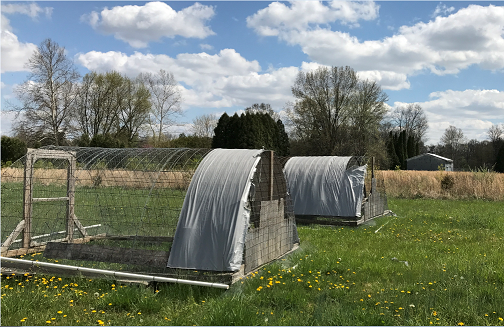
    1. Put in rear vertical attaching the top to the hoop with fence nails.  Attach the diagonal supports.
      1. Add your end material for additional shelter.  Note: This side of the tractor will go to the most windward side, west for me.  The upper section is just covered by the tarp and can be raised for additional air flow. (don’t attach tarp yet)
    1. Cover the hoop with chicken wire, 3 passes of 4′.  Overlap slightly. Staple to wood frame and zip tie together and to the hoop.  I use a pneumatic staple gun with 5/8 staples, but a hand stapler should work fine, especially if you use a hammer afterwards to ensure they are tight.
      1. Note: If you don’t have a continuous 75′, such as two rolls of  50′ and 25′, plan it out first.  Cover the hoop, then back.  Save the front (door end) for last as it uses  3 smaller pieces.
    1. Cover the back and front sections and door with chicken wire.
      1. Note: the bottom 2′ will be hardware cloth and the upper section will be chicken wire.
        1. If you purchased 75′ you should be able to piece together the entire door and sides if you prefer.  I do the front and rear end across bottom with hardware cloth,  then the piece in the tops with the chicken wire.
    1. Surround the perimeter with 2′ hardware cloth.  I added this to stop predators from reaching in through the chicken wire and grabbing birds sleeping near the edge.
      1. Cover the back bottom 2′ that isn’t protected by your end material with  Hardware cloth.  Optionally you can cover the entire back for extra protection depending on what back end material you used.
      1. Start from the back and move to the front.
      1. Note:  If you don’t have 50′ continuous role, plan you’re cuts accordingly. IE, for 2 25′ roles, start in the back and wrap up to the door using one role for each side.  Then do the door.
    1. Add 2×4 fencing to ends.  This is added for K-9/coyote protection.  Three foot  doesn’t make it impossible for a K-9 to get over it, but that height with the chicken wire too makes for pretty good protection.  So far we’ve survived 2 K-9 attacks.
      1. Note:  Use a type/size predators cannot force through.  I use 2×4 3′ 14 gauge welded wire.
    1. Attach door with hinges and add latches and handle.
    1. Cover 2/3 of the hoop with the tarp, wrap extra around back.  Staple the tarp to the wood base and wire tie the eyelets to the hoop.
      1. Note:  My medium duty tarps last one season.  I remove and re-add each season.
    1. BONUS: Add an apron to the front and back for added protection.  You can also do the sides.
      1. Staple 12-14′ of 2′ hardware cloth to the front and back base, leaving 1-2′ of overlap past the tractor.  I try to leave it a little loose so it has a little “hinge” to it.   I don’t know that it’s required.
      1. Wire tie a PVC  pipe to opposite end of the hardware cloth for weight.
        1. Note:  If you cut the PVC end of the hardware cloth and bend the points down, it’s more of a deterrent for critters that might burrow under.

-Jason


Copyright © 2018 by Jason Maples